
The primer for beautiful plants is beautiful soil.
Copyright © 2011 Dianne Marie Andre

The primer for beautiful plants is beautiful soil.
Copyright © 2011 Dianne Marie Andre
Whether you’re a novice, passionate or occasional gardener, by following a few steps you can keep your plants looking their best. These simple effective steps introduce you to the basics of maintaining healthy plants that will reward you for years to come.
Nitrogen (N) promotes vigorous leaf growth. Phosphorus (P) encourages good development of roots, flowers, and fruit. Potassium (K) promotes cell division and strong stems.
Follow the above tips and your plants will give you satisfying results year after year. Remember, small regular maintenance is easier than a field of copious tasks. Copyright © 2011 Dianne Marie Andre
Deciduous:
Trees or shrubs (usually evergreens) that lose their leaves in the fall.
Evergreen:
Plants that keep their leaves or needles year round, but lose some.

Yeah for yesterday.
First came the sun, then the moon, full and bright.
What will today bring?
I put on my coat, just before sunset, and went to the henhouse. As usual, the evening air was cold so I hurried to secure eleven hens and one pet turkey for the night. Standing outside the running pen, I locked the hatch then opened the coop door to gather eggs.
Although I was moving quickly to get out of the cold, I slowed down to peek into the nesting boxes. The first box cradled two brown eggs, the second box had a green egg, the third was empty, and the fourth (this reads like Goldilocks) held an unusual surprise, one XXL-egg, and one XXS-egg. As I held the two oddball eggs, one in each palm, I smiled then chuckled. The exaggerated sizes were as laughable as looking at a Great Dane and a Chihuahua standing side-by-side.
After I said good night to the hens, I returned to the house with three normal-sized eggs and two abnormal ones. Once inside, I measured them. The XXL-egg was nearly four inches long by six-and-a-half inches in diameter. (Ouch!) The XXS-egg was three-inches around and only one inch long—not exactly edible. However, the larger egg will make a mighty fine omelet. What better way to start my day than with a meal packed full of organic goodness. Likewise, the quiet gathering of eggs is a perfect threshold to the passing of a day. Copyright © 2011 Dianne Marie Andre
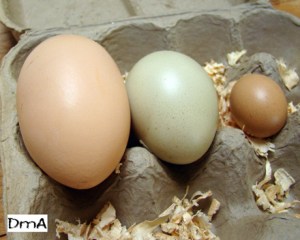
Left to right: XXL, Normal Size, XXS
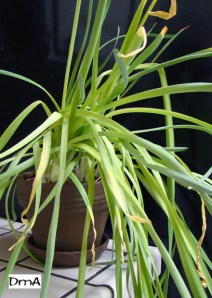
Indoor blooms don’t just happen. As you can see in the photo, my Narcissus Paperwhites are flowerless. This was my first experience with indoor bulb forcing, which I shared with my readers in November. You can review my original posts by clicking on these three links:
Day 8 of forcing Narcissus Paperwhites Indoors
At first, my Paperwhites flourished. Two buds burst into tiny white flowers and bloomed for nearly three weeks. I was ecstatic. Everyday I watched for more blossoms with eager anticipation. Buds continued to form. As the foliage grew, my excitement heightened because I looked forward to a happy plant covered in florets. Then the flowers as well as the buds died. I was devastated and couldn’t understand what happened because the bulbs were healthy and firm. It was obvious I had failed them, and I wanted to know why.
Since I couldn’t find the answer online, I called a local nursery for some practical advice. The owner answered the phone and said, “I don’t know, but come in and buy ours. Our bulbs would never do that.”
Frustrated, I sought help elsewhere. Here’s what had I learned:
“Narcissus bloom when it is cold out. They like it cold and wet. They usually yellow when the air is too dry, and soil too dry.” –Julie Morehouse, Horticultural Advisor/Garden Coach, Stockton, CA | 209-598-4707
“You under-watered, once the bulbs flower the water evaporates quickly. They need more water to keep blooming.” –Bill Renfro, owner of Plants and Produce Retail Nursery, Lodi, CA | 209-727-0323
BINGO! I finally knew what I did wrong and how to avoid failure next time. My potted Narcissus sat in a warm, dry room. I was so concerned about over watering, the soil was barely moist, and with too many holiday festivities, I probably let it dehydrate more than once. Although my oversight wasn’t costly, I was disappointed with the results of my neglect.
If you are thinking of forcing indoor flowers, whatever variety bulb you choose, benefit from my mistakes—research environment, water needs and other growing requirements for successful indoor bulb flowering. Copyright © 2011 Dianne Marie Andre
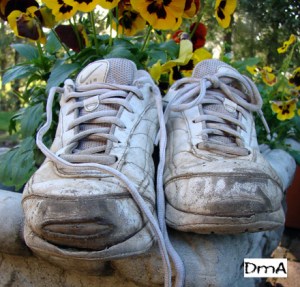
Ornamental:
Plants grown mostly for their beautiful foliage or flowers, not consumption.
Native:
Plants that will grow in the same habitat from which they originated that can include a continent, state, or region.
Vegetable:
A plant that has edible leaves or stems.
If you look on the sidebar, you’ll see a new page titled Media. I’m proud as a new parent when a publication mentions inandaroundthegarden.net. Last year, there were two write-ups. Not bad for a first-year blogger. The Media page is my way of saying thanks to the writers and the business owners. I hope you’ll support them with a visit, and tell them inandaroundthegarden.net sent you.
What is Sustainable Gardening?
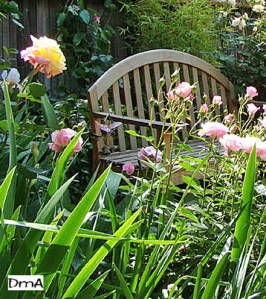 For centuries, we have been developing a deeper understanding of our world and with the help of environmental sciences and agricultural researchers, better methods that enrich our planet are being discovered. Today, many commercial growers and home gardeners are turning to organic practices or sustainable gardening.
Sustainable gardening is choosing a technique that heals and improves the environment. Applications do not necessarily have to be 100 percent organic but even partial changes are beneficial. Gentle-earth-loving methods like controlling weeds, amending the soil as simple as using recycled kitchen waste, creates a healthier earth, food, and beautiful landscapes for future generations.
Sustainable gardening works well in many topographical areas, including urban landscape development, farming, and agriculture. Whether you are a grower, landscaper or a backyard gardener, the goal is the same: To practice energy-saving methods and earth-friendly techniques that meet the ever-changing global climate. Sustainable gardening methods include:
Landscape architect Owen Dell, author of Sustainable Landscaping for Dummies describes sustainable landscape as a way to:
To view some of Dell’s sustainable landscapes go to www.owendell.com/Projects/index.html.
Furthermore, when Sustainable Sites Initiative (SITES) established a pilot program for LEED* certification in June 2010, SITES defined sustainable as:
. . . design, construction, operations and maintenance practices that meet the needs of the present without compromising the ability of future generations to meet their own needs by attempting to: protect, restore and enhance the ability of landscapes to provide ecosystem servicesthat benefit humans and other organisms.
In other words, sustainable gardening is a combined effort using organic methods and harmless-living practices for a healthier earth and cleaner heavens. Copyright © 2011 Dianne Marie Andre
*LEED is an internationally recognized green building certification system, providing third-party verification that a building or community was designed and built using strategies aimed at improving performance across all the metrics that matter most: energy savings, water efficiency, CO2 emissions reduction, improved indoor environmental quality, and stewardship of resources and sensitivity to their impacts. For more information on LEED go to: www.usgbc.org/DisplayPage.aspx?CategoryID=19
If you had problems with my link http://www.twitter.com/dianneandre it should work now. Sorry for the inconvenience. Have a great day.


 | Aimee E on Slanted Light |
 | Anonymous on A Lesson in Forced Blub F… |
 | Corinne W on I have Argyranthemum Frut… |
 | Dianne Marie Andre on How to Deadhead Snapdrago… |
| Anonymous on How to Deadhead Snapdrago… |

 In and Around the Garden