Pome:
Fleshy fruit with leathery core such as apple, pear, and quince.

Pome:
Fleshy fruit with leathery core such as apple, pear, and quince.

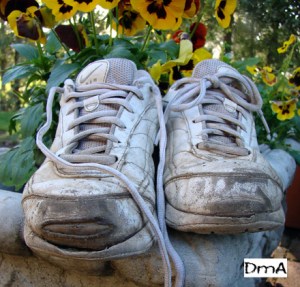
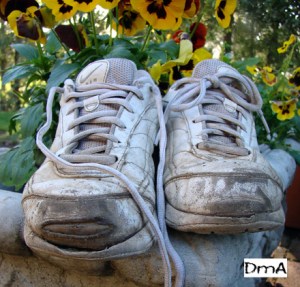
When the rains came earlier this week, the landline died.
No telephone calls, incoming or outgoing.
No emails, blog posting, or cyber research.
No cellphone reception in rural-area dwelling.
Just old-fashioned living. Simple archaic existence.
— Copyright © 2011 Dianne Marie Andre
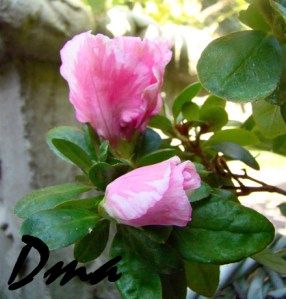 Fall and spring are the prettiest times of the year, so why not fill your landscape with the impressive hues of both seasons. Here are a few suggestions.
For flowers that reflect spring colors choose pinks, whites, blues, and yellows. Complimentary fall blooms include bronze-orange, gold, purple, and rust to brownish red.
Shrubs like azaleas (left photo) and camellias provide spring-colored flowers. Encore Azaleas require full shade and blooms three times a year with leathery leaves that remain green year round. Springtime is the shrub’s biggest bloom period. There are fewer blooms in summer and autumn. Still, the fall display is colorful until the first frost.
Camellias grow in part to full shade. Choose the Camellia sasanqua species for blooms October through December. For blossoms January until April, plant japonica species.
There are many perennials with fall blossoms of pinks, whites, blues, and yellows. Some to consider are boltonia asteroides (white and light pink), asters (rose and pink including fall hues), Chrysanthemum hosmariense (white with yellow centers), Russian sage (lavender), Sedum ‘Brilliant’ (pink).
Jackie Tarchala, owner of What Grows Where-consulting and design, says her favorite trees for fall color are, “Liquidamber, Pistacia chinensis, and all the Acer’s, especially A. rubrum ‘Autumn Blaze’ and A. ‘October Glory’”.
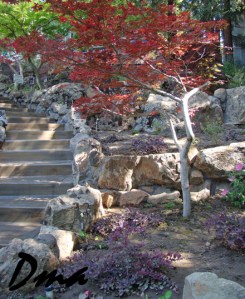 Shrubs with fall foliage are Burning Bush (Euonymus alatus), Oakleaf hydrangea (Hydrangea quercifolia), Barberry (Berberis), Blueberry (Vaccinium), Virginia Sweetspire (Itea virginica), and much more.
Frond:
The branch and leaf structure of a fern or members of the palm family
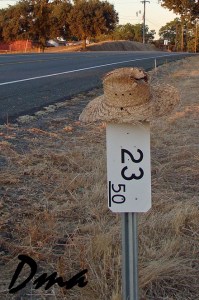
This old straw hat blends in with the dry weeds so well it’s easy to miss while driving by, unless you’re a gardener. What do you think; did the wind sweep the hat away when the owner tilted his or her head out an open car window? Did somebody toss the hat out the car window on purpose? Did the hat just happen to land on this makeshift roadside hat rack? Was it placed there—then forgotten—by one of the road crewmen while weed eating the dry fire hazard?
Whatever the story is of this old straw hat, there are other ‘gardening’ things to think about–fun, educational, family activities and much more–listed on the October Calendar of Events. Click on the sidebar on ‘today’s date’ on the little calendar or on ‘Events’ under Page.
If you decide to attend a bright, sun-lite, outdoor activity, I know where you can get a free hat!

I’ve heard it said that praying mantids (plural/refers to entire group) are a sign of good fortune. Since I’ve spotted four or five the past couple of months, I expect an incredible future in and around my garden, and in my life. How about you? Have you spotted a mantis (singular) lately?

This California mantis clung to my screen door for three weeks. Its milky-white color indicates that it just completed one of the ten molting stages mantids undergo before achieving adult size.

Here is a California mantis creeping along the garage floor. I left the mantis to find the nearby plants where it will prey on bad and good bugs: grasshoppers, ants, moths, crickets, gnats, mealworms, grubs, termites, maggots, katydids, aphids, most flies, mosquitos, butterflies, ladybugs, spiders, worms.
Other Interesting Facts:
Tip: When doing your fall pruning, look for mantids eggs on branches, twigs, walls, fences or eaves. If possible, don’t prune the branch or place it in a protective area of the garden, off the ground where ants quickly consume them. Follow the same procedure if you remove mantids eggs from a wall. The nymphs will survive.
 If you’re a little behind schedule like me, there’s still time to get cool-weather seeds in the ground. Growing from seed is the most economical way to bring ‘healthy’ food to the table, and there are more available seed varieties than seedlings. Although starting seeds indoors provides a jump-start if done earlier, sowing seeds directly in the garden takes less work and avoids transplant shock. All you need to direct sow cool-weather seeds is a little time for soil prep, garden tools, gloves, and water.
Soil Prep for Direct Sowing Includes:
Once the soil prepared it’s time to direct sow seeds. Here’s a list of cool-weather seeds sown in September:
Follow seed packet instructions for depth and spacing. Seeds sown directly on top of the soil need light to germinate. To keep these from washing away, use a hose wand set on a gentle ‘shower’. Buried seeds require less caution while watering but need moist soil. Label what you planted where and watch your crop grow.
Note: Most seeds need warm soil to germinate and grow to a sufficient size. If a cold spell is in the forecast during germination and early seedling stage and you have a small garden, cover the soil with clear plastic. Be sure to ventilate or uncover if the temperatures are warm in the afternoons.
For a list of September gardening chores check out “Monthly Tasks” on the sidebar.

Cyme:
A flat-topped or domed flower head in which the center flowers open first.

My favorite ground cover is Lysimacha Goldii (Lysimachia nummularia ‘Goldii’). This low-growing evergreen thrives in full sun or semi-shade. The trailing, golden highlights add a stunning pop of color. Mine is growing between flagstones and in an otherwise drab area of the perennial garden. I planted Lysimacha Goldii several years ago and it always looks beautiful, unlike some mature ground covers that get woody and dull.
Lysimachia Goldii is easy to grow and is beautiful cascading over walls, pots, and hanging baskets. Best of all, it’s a cool pet bed on hot summer days.

Note: If your pet loves to gnaw on vegetation, ASPCA has a list of toxic plants. However, their files are not complete and Lysimachia Goldii is not listed.
You are currently browsing the archives for the Dianne's Blog category.


 | Aimee E on Slanted Light |
 | Anonymous on A Lesson in Forced Blub F… |
 | Corinne W on I have Argyranthemum Frut… |
 | Dianne Marie Andre on How to Deadhead Snapdrago… |
| Anonymous on How to Deadhead Snapdrago… |

 In and Around the Garden