Archive for the ‘Dianne's Blog’ Category

h1

Soulful Plotting

May 6, 2011

Rhizome:

A thickened stem (storage organ, capable of storing food), with roots growing from it, which grows horizontally below or on the soil surface. New growth then emerges from different points of the rhizome. Examples Bearded Irises, Calla Lily and some lawn grasses are rhizome plants.

h1

I’m Back!

May 6, 2011

In case you’re wondering why I haven’t posted since Monday, here’s an account of what has happened.

Tuesday, May 03:  As soon as I managed to get my new, hand-me-down computer running the landlines died. Until today, I couldn’t communicate with the world via telephone or cyberspace. I couldn’t check incoming emails, conduct internet research, or publicize Wednesday’s Guest Writer’s article.

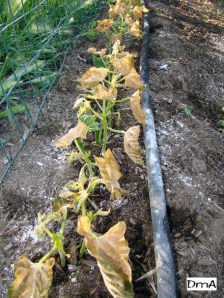
In addition, two of my county fair entries were damaged (my fault) and my green bean seedlings that appeared happy and perky on Monday turned into crispy, brown foliage today.

The beans are growing along a fence line between a row of vigorous snow peas and asparagus bean seedlings. The brown green beans no longer blend beautifully between its neighbors. Like an unkempt front yard in the middle of well-groomed landscapes, the green beans are an eyesore.

I hadn’t fertilized. It wasn’t windy. The soil was damp so there’s no logical reason for fried leaves. It’s just one of those mysterious disorders that oftentimes leaves the caregiver baffled.

Since the stalks look good, I’m going to watch them for a week. If new leaf buds appear, I won’t replant. Replanting now would put harvest off for month.

The lifeless landlines, damaged county fair entries, and impaired bean crop are minor setbacks, slight disappointments. However, the distant roar of heavy equipment that woke me from a ten-minute snooze this afternoon was anything but trivial. More on this next week. 

Thursday, May 05:  Late afternoon Verizon repaired my landlines, and my hand-me-down computer is running smoothly. Now, though, the “service engine soon light” in my car lite up like a huge hotel sign. Tomorrow, I’ll have to take it into the shop which means I won’t have transportation to the Amador Master Gardeners’ annual plant sale to volunteer with set up and sales—a fun day that I will miss.

The good news is that Wednesday’s article, written by Guest Writer Bernadine Chapman-Cruz,  will be posted Saturday.  (There’s always something good to look  toward.) Stayed tuned for tomorrow’s Soulful Plotting and Bernadine’s article on the history of Mother’s Day.

h1

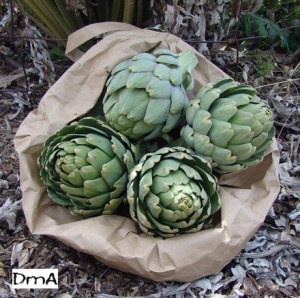
Artichoke Facts

May 2, 2011

Artichokes

Scientific NameCynara scolymus

Description:  Artichokes are large thistle-like perennials with silver-leaves. The bud or vegetable has prickly petals. When artichoke buds are left to bloom they produce beautiful lavender flowers.

History:  The French are credited with bringing the first artichokes to the U.S. during the early 1900’s. By the 1920’s artichokes were being shipped to the east coast. Soon Half Moon Bay billed itself as the artichoke capital of the world.

Nutritional Value:

½ cup, boiled =

Calories 37

Fat 9.1 g

Calories from fat 2%

Sodium 55 mg

Protein 1.9 g

Carbohydrate 8.7 g

Planting Tips:  Artichokes prefer cool, moist summers with mild winters but usually do well in some hot climates. Depending on the variety and climate, artichokes can be grown as a perennial or annual.

Plant artichokes in early fall, late winter or early spring after last frost date. Start seed, rooted offshoots, or divisions from mature plants. Plant in full sun, in rich well-drained soil with plenty of organic matter. Fertilize in early spring. Artichokes love water so keep moist and mulch deep. Some buds will develop the first spring but a good crop usually starts one year after planting. Plants mature in size 3×3 feet but can grow up to 8 feet wide and 4 feet high so allow room for growth.

Watch for aphids, earwigs, slugs, and snails. Every three or four years, dig up and divide otherwise production will decline from overcrowding.

Harvest Tips: Harvest while buds are tight and two to four inches in diameter. Cut the stem two or three inches below the bud. The California Master Gardener Handbook says, “A recommended cultural procedure is to cut the entire plant down to, or slightly below soil level after the spring production peak. Reduce irrigation for several weeks. Once you resume irrigation, it encourages rapid and vigorous regrowth bearing new buds for fall production period.”

Recommended Varieties:  Imperial Star, Emerald, Big Heart, Desert Globe, Green Globe. Check with your local nursery for varieties that grow best in your zone.

Copyright © 2011 Dianne Marie Andre

h1

Soulful Plotting

April 29, 2011

Runner:

A slender creeping or, trailing stem which produces small plants along the length wherever its leaf and bud parts come in contact with the soil. These nodes and root tips are called stolons. The new plant can be severed from the parent after it has developed sufficient roots. A strawberry plant is an example of a plant that develops runners.

h1

Science in the Garden

April 25, 2011

New Citrus Variety is Very Sweet, Juicy and Low-Seeded

A new mandarin variety, ‘KinnowLS’ (the LS is short for low seeded), has been developed. It’s very sweet, juicy, and low-seeded. “People who like very sweet fruit are going to find ‘KinnowLS’ to be very appealing,” said Mikeal Roose, a professor of genetics in, and chair of, the Department of Botany and Plant Sciences, who developed ‘KinnowLS’ along with staff scientist Timothy Williams.

‘KinnowLS’ can be grown in California’s desert regions because the fruit, which matures during February through April, does well in hot climates.

Currently, plans are to distribute ‘KinnowLS’ budwood, starting June 2011, to only licensed nurseries in California. For three years, only California nurseries will be permitted to propagate ‘KinnowLS.’ Licenses for ‘KinnowLS’ propagation outside the United States will be issued thereafter. KinnowLS will not arrive in U.S. produce aisles for at least five years. —  University of California – Riverside 2011, April 11.

Europe’s Wildlife under Threat from Nitrogen, Study Warns

A new international study warns that nitrogen pollution, resulting from industry and agriculture, is putting wildlife in Europe’s at risk. More than 60 per cent of the EU’s most important wildlife sites receive aerial nitrogen pollution inputs above sustainable levels.

Dr Kevin Hicks, of the SEI at the University of York, said, “While the nitrogen impacts on plant species are relatively well understood its effects on other wildlife, such as butterflies, and the consequent implications for biodiversity are not so clear.”

A team of scientists, conservation and environmental managers and policy makers from across Europe, co-ordinated by the Stockholm Environment Institute at the University of York, reviewed evidence from across Europe. The study confirmed nitrogen deposition as a major threat to biodiversity in the Natura 2000 network established under the Community’s Habitats Directive to safeguard important habitats and species. —  University of York 2011, April 14.

h1

Soulful Plotting

April 22, 2011

Erosion

The washing away or removal of soil created by wind, water or man.

Mulching or planting cover crops after the last harvest helps to prevent wintertime erosion.

h1

A Weekend of Celebrations, Pullets, and Gardening

April 18, 2011

It was a busy weekend filled with outdoor activities and a couple of celebrations. Ralphie turned two years old last Friday, on the day of my wedding anniversary. He enjoyed a new doggie treat, and my husband, Joe, and I had a good meal out, a gift from a high school friend. Thanks Irene.

Saturday, I volunteered at the Amador Master Gardeners’ first spring workshop. Several MGs (master gardeners) shared tips on a variety of topics from how to make different tomato cages to growing “not your ordinary vegetables,” to eatable lilies and recipes for an impending bounty. Afterwards, I joined fellow MG’s Barbara Dahlberg, Kathy Freeman, and Glen Johnson at the demo garden. This year’s major projects are building a tool shed and deer fence. Saturday, we focused on the fence. Glen used some sort of hydraulic post driver and within an hour, he completed the job. A few dozen T-posts stood vertical without the aid of human hands.
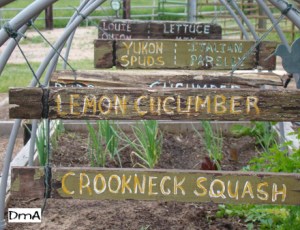
Sunday, I planted cucumbers, squash, tomatoes, and melons, painted vegetable signs, mulched a flowerbed, and worked in the perennial garden. Joe finished grouting the tile in my garden house,  then got busy with outdoor chores with Ralphie by his side. Mid-day, Joe and I decided to buy a few pullets (chicks). Usually, we get new pullets every other year. But we’ve learned in order to keep a steady flow of eggs, we need to add to the flock each spring. After a short drive to Lees’ Lockeford Hay Station, we made our selections. We now have two Silkie Bantams (these are for fun as they are a petite breed and produce tiny eggs), two Black Australorp, and three Buttercups in a small cow trough here in the garage. They are safe and warm under a heat lamp with feed and fresh water to nourish them along. When they’re old enough, I’ll house them in the coop (separate from the layers) and later in the running pen. The goal is to eventually let them free range, when they’re bigger and have common sense to return to the coop at night.
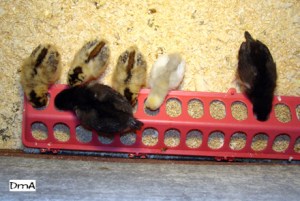
As Sunday wound down, the power went out. Forced to stop activities, Joe and I had to find our way in a dark house for flashlights, matches, and candles. We brought the pullets inside where warm logs were burning in the fireplace. Once the pullets were calm, we snacked by candlelight on sandwiches, applesauce, and chips. Our home was filled with the sounds of little chirps, crackling logs, and a barking dog. The weekend was active, even into the twilight. I was tired, after working at a gardening workshop, fence building, tucking seeds and seedlings into the earth, sign painting, tending to perennial plants, adopting pullets and celebrations honored. But it was a tired that felt good. That’s how productive, long sunny days are in and around the garden. Copyright © 2011 Dianne Marie Andre

h1

Soulful Plotting

April 15, 2011

Fungicide:

A chemical used to

protect against,

inhibit, or kill

plant diseases caused by fungi.

h1

Ten Don’ts for Better Gardening

April 11, 2011

Gardening mistakes happen just as they do with any endeavor. I’ve made plenty of blunders in both the perennial and vegetable gardens. Still, I never give up and it’s my hope that you won’t either. To help you avoid the same gardening errors, here are the most common mistakes made by just about every gardener.

  1. Over watering:  Potted plant roots can drown when over watered. Giving too much water to ground plantings encourages shallow roots stressing the plants. A dry surface doesn’t mean the soil is dry below. Use a water meter or work your finger or a trowel into the soil about six inches to determine if the soil is dry.
  2. Lack of Soil Awareness:  Understanding what type of soil you have and what nutrients it may need is the first step to maintaining healthy plants. Start with a soil test then amend accordingly with organic matter. Enriching the soil with compost before planting, and once or twice a year thereafter will give your plants a healthy start and keep them happy.
  3. Unfamiliar with exposure:  While one planting area may receive eight hours of full sun, another spot only three feet away could get much less. Know each area’s microclimate before choosing suitable plants or trees.
  4. Poor reading habit:  Plant tags tell you if the plant is an annual or perennial, zone, drought tolerate, where to plant, when to plant, maturity size (height and width), proper spacing, light, and water needs.
  5. Wrong placement:  Don’t place shrubs or trees that will grow 30-feet wide only 5-feet from a building or other plantings. Always look up. Are there any utility wires? Check with your local utility company for recommendations and for any underground lines.
  6. Improper Planting:  Placing the base of plants below ground level creates a pool where water can sit around the trunk, rot, and drown roots. To high above the surface and roots are exposed. Holes should be twice as wide with the sides roughed up. The depth should be six inches deeper than the container with a garden soil mixture and organic matter six inches at the bottom.
  7. Improper Mulching:  Mulch helps retain moisture, improves soil structure, and controls weeds but placing mulch too close to trunks is an invitation to root rot, rodents, insects, and disease. Mulch should be at least three inches from the base.
  8. Plants that don’t fit your lifestyle:  If you don’t have the time or simply don’t enjoy pruning, trimming, or deadheading but want an attractive, neat and tidy yard take the time to select low-maintenance plants. Don’t like to rake leaves, avoid deciduous plants and trees. Stay away from shrubs and vines that require weekly pruning or daily watering. Dodge plants that are disease prone.
  9. Container gardening:  Like all vegetation, potted plants need air circulation. Sit pots on risers, available at nurseries or make your own out of 2x4s cut a tad shorter than the pot’s diameter so nobody trips. If your pots are sitting in a saucer, add an inch or two of pebbles.
  10. Impulsive buying:  Avoid it!

Copyright © 2011 Dianne Marie Andre

h1

Soulful Plotting

April 8, 2011

Fungus:

A primitive form of plant life known to houseplant growers as the most

common cause of infectious disease

such as powdery mildew and sooty mold.