h1

The Weekend: What I did, discovered, and sat on

June 5, 2011

Fair time

Throughout the countryside, fairground employees are gearing up for community showmanship, amusement rides, entertainment, and food.  For months, entrants—adults and youth—have been working hard at their particular craft, from wine making to hog rearing, constructing bottle rockets to canning pickles, and much more. Hundreds of people convey his or her skill in one form or another at the fair.  I am one of those people.

Friday, with my exhibits in the backseat, I drove to the fairgrounds with a smile on my face and hope in my heart. This is my fourth year entering amateur photography exhibits, and first year venturing into the craft arena.

Every year, I have blue-ribbon dreams and even though I’ve only won a couple, I still walk away pleased for having tried. Sharing one’s craft isn’t just about blue ribbons. It’s about creative thinking, goal setting, and staying up all night to finish what you started. I may not walk away a champion but I will have expanded my inventive juices and had fun along the way. I’ll let you know, when I know, if I won a blue ribbon.

Amy Stewart

If you didn’t make it through the rain to Amy Stewart’s presentation, you missed an enjoyable, educational afternoon. I’ve heard her speak twice now and Stewart is an excellent presenter.

While conducting research for her books, Stewart looks for little, or unknown, facts. As a speaker, she brings her research to life in a friendly, educational, but humorous way. One shocking fact that Stewart shared from her latest book, Wicked Bugs, is that the world contains 10 quintillion insects. That’s 200-million bugs per person. They out number us, and unfortunately, we can’t exist without them. After telling the crowd this shocking fact, Stewart went on the say that the good news is, most bugs can’t hurt us. Bugs are not physically able to penetrate the skin even if they wanted to. However, “There is a dark side of the bug world,” Stewart said, “but not much.”

You’ll have to read her book to learn more on wicked bugs.

Karma

Before Amy Stewart’s presentation began, I noticed a familiar-looking love seat at the back of the room. Upon closer examination, and after plopping on the cushion, I floated down memory lane. At one time, I was its first owner. I also had a matching sofa with throw pillows, and coordinating window valances. Country blue was the trend back then and I went all out.

Somehow, the love seat made its way from my garage sale (where I sold the set to a Lodi couple) to Concord, past Clements to Sutter Creek. You never know what, when, where, or how karma will surface. In this case, in the form of a love seat still wearing well despite a split up with its partner, the blue sofa.
h1

Soulful Plotting

June 3, 2011

Legume

A plant of the leguminosae family that bears a pod, splits along its two seams and releases the enclosed seeds upon maturity. Legumes are nitrogen fixers reducing the need for nitrogen and soil improvement fertilizer. Legume examples:  pea, bean, clover and alfalfa

h1

Meet Amy Stewart

June 2, 2011

Spend the afternoon with New York Times’ best-selling author Amy Stewart. She will give a presentation based on her latest book, “Wicked Bugs.”

All five of Stewart’s books will be available for purchase at this FREE event. After the presentation, Stewart will be available to sign copies of her current and earlier books.

The event is FREE! But seating is limited so please reserve your spot soon. Contact: Master Gardener Jerry Trottier at 209-223-9133 or visit the web at http://ceamador.ucdavis.edu/Master_Gardener/Master_Gardeners_Presentations.htm

When: June 4th, 2011, 2:00 pm
Where: United Methodist Social Hall, Main Street, Sutter Creek, CA.

Event sponsored by Amador County Master Gardeners.

See you there!

h1

Preparing to Defend my Flock

June 1, 2011

MyFreeCopyright.com Registered & Protected

A predator crept onto the property then quietly left with a hen in its mouth. I didn’t witness the scene but that evening when I stepped into the running pen to gather eggs, a large clump of feathers and hide was lying beside the feeder. The headcount was one less.

I had spent most of that day outside spreading wood chips. I didn’t hear a peep. No loud squawks. No rush of flapping wings. No warning honks from my pet turkey, Miss Boo Boo. On the rare occasion that the chickens have fled for safety, I’d hear their shrieks from inside my house. This time, I didn’t even hear them while I was working outdoors. Whatever species the predator, it was sneaky, rapid, inaudible as a silent movie, and as deadly as a bear trap.

The next evening, a sick hen that I had nursed died. For several days, I had carried her to the water bowl then the feeder.  She seemed happy to be eating and drinking. Still she was fading. Afterwards, I’d put her into a nesting box to protect her from the other hens. A flock will peck at a sick or injured hen to establish hierarchy status or to remove a weak member.  It’s a terrible scene to encounter so I do everything possible to stop muggings in the running pen.

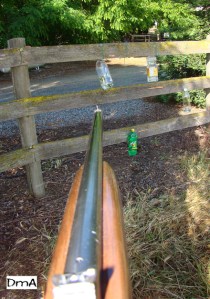
When I discovered the hen’s body in the nesting box, it was late and nearly dark so I laid her in the tall weeds outside the coop. Early the next morning I returned to bury her but the mysterious predator had come back. (The details are too horrible to share.) Angry with myself, and the beast that robbed a hard-working chicken of a dignified, humane burial, I decided it was time to learn how to handle a gun. Later, I called my son, Jason, and the following weekend he came over with his 22. He set up water bottles then gave me safety instructions and shooting lessons.

The distance between the stock and the barrel was a little long for my short arms and my eyes kept seeing double. Still, I managed to hit the bottles. I also hit the nearby silver maple leaves and the foxtails. When Jason went home, he left his gun so I could practice. Having done so several days now, I realize that by the time I get to the gun, unzip the case, take out the 22, get to the bullets, load, and go outside, the predator will have eaten the whole flock. I suppose I’ll have to set up camp in the running pen. I too can be a sneaky, inaudible predator. Copyright © Dianne Marie Andre

h1

Enjoy Today’s Holiday plus June Fun

May 30, 2011

Happy Memorial Day! Put out the flag, have a BBQ, enjoy family and friends in the garden, then check out June events for more fun in the weeks to come.

h1

Soulful Plotting

May 27, 2011

Bract:

A modified leaf, with or without a stem, that’s usually located at the base of a flower. Often confused with the flower itself, fruit(s), or a cluster of flowers such as Poinsettia and Bougainvillea that are actually bracts surrounding the tiny central flowers.

h1

2011 First Harvest

May 27, 2011

Yum! Today, I ate my first tomato of the season. Sorry there’s no photo to show you the little beauty, but I couldn’t wait to get it into my mouth.

h1

Container Gardening Part III: Plant Selection and Growing Tips

May 25, 2011

MyFreeCopyright.com Registered & Protected

Tips:

  • If recycling old containers clean thoroughly with 1-part bleach to 3-parts water.
  • When reusing an oversized pot, place a thick layer of vermiculite, perlite, or Styrofoam at the bottom before filling with potting mix. This will reduce weight and improve drainage.
  • Know how much exposure the area receives and choose plants accordingly.
  • Not all perennials, fruit trees, and vegetables do well in containers. Read plant tags or ask for assistance.

Selection:

  • When putting more than one variety per pot, select plants with the same sun and water requirements.
  • For a stately look, surround a single shrub or tall plant with colorful flowers.
  • Blooming vines create an impressive cascading display.
  • In shady areas use bright flowers, variegated leaves, and striking foliage and texture that will show off against a dark glazed ceramic pot.
  • A bowl of succulents requires little water and fertilizer, and adds smooth texture to sunny spots on tabletops. But most succulents need protection from winter weather.
  • Grow a salad container off the kitchen in a sunny place filled with sage, sweet marjoram, patio tomato, nasturtiums, Italian parsley, and basil.
  • Anchor a bench with LARGE, stately containers and colorful plants.
  • If you’re less inclined to water regularly, go with drought-tolerant plants, moisture control potting mix, a timer, and drip line.

Planting and Care:

  • A good potting mix is key to healthy, happy plants. Don’t go the cheap route when it comes to soil.
  • Leave two – three inches from the top of the pot to hold water. This will keep water from running off the soil before penetrating the roots.
  • After you’ve planted, sprinkle in a time-release fertilizer according to package instructions or feed every two – three weeks with a liquid or granular fertilizer. Always follow label instructions.
  • A soaker ring connected to a water line provides even, reliable watering. Check the emitters periodically for clogging.
  • Deadhead faded flowers for continuous performance.
  • Water according to the plants’ needs.

© Copyright Dianne Marie Andre

h1

Container Gardening Part II: Shopping Guidelines

May 23, 2011

MyFreeCopyright.com Registered & Protected

In Container Gardening Part I: Available Choices, I shared the types of pots offered. Here are some helpful tips to consider before you go shopping:

Size:  Roots need air circulation and plenty of soil for adequate root growth. Annuals don’t need as much soil as perennials but all plants need plenty of oxygen. Vigorous growers require repotting more often but don’t overwhelm plants in a huge pot. It will look unbalanced. A reputable nursery person can help you pick the right size for your plants.

Drainage:  All planters must have drainage holes. Even if you are putting a potted plant with holes inside a decorative planter don’t let it sit in the accumulated water at the bottom. Place an inch of gravel at the bottom of the decorative planter so the inserted pot sits above the water. Empty the water as needed.

Weight:  Consider the heaviness. Do you want it to be mobile? Will you be able to move it? Is there enough surface support for a single pot or companion pots if grouping several together?

Oxygen:  All containers should sit off the ground for airflow. Most nurseries sale pot feet or you can use brick or cut a couple of lengths out of scrape wood.

Durability:  If you’re buying large planters that are too heavy to move during the cold season, choose winter-proof pots such as wood, metal, or concrete. For regions with extreme heat, don’t use material that absorbs heat (dark metal and terra cotta) as it can burn the roots. Some glazed ceramic pots won’t hold up in regions where climates fluctuate from extreme high to low temperatures.

Color and Style:  Part of the fun of container gardening is choosing pottery. If you’re new to container gardening and unsure where to begin, here’s a list of questions to help you make the right choices.

  • Match pots to the style of your home. Is it ranch, Victorian, contemporary, bungalow, traditional, cottage, Spanish?
  • Are the exterior walls bright or drab, in need of color? If the walls are dark, a light color container will pop and vise versa.
  • Do you want to see your container garden from inside the house? If so, are the plants tall enough? Do you need hanging planters, window boxes, or potted vines with a trellis?
  • Is there a nearby faucet and hose for easy watering or installing a drip line and timer?
  • Do you want to show off the pot, your green thumb, or both?
  • Do you want to create a bold statement, repeat a focal point throughout the garden or yard, or a warm welcome statement?
  • Do you want a succession of matching planters along a path?
  • When doing a grouping, do you prefer identical material or an eclectic flair?

Helpful Tips:

  • When considering color, remember that dark-colored pots will fade; some pots fade during the first season while others may last longer.
  • For container groupings use different heights and sizes of both planters and plants.
  • Water coming from the drainage holes can leave rust or water stains on concrete or wood surfaces. Put a tray under your elevated pot. Line window boxes with a good drip pan so water won’t run down the side of your walls and cause stains. Mount box so there’s a good gap for air circulation otherwise moisture will get trapped and cause rotting to windowsill or siding. © Copyright Dianne Marie Andre
h1

Soulful Plotting

May 20, 2011

Whorl/Whorled:

Buds, flowers, leaves or shoots growing from the same (single) node,

usually three or more. These leaves are not alternate nor opposite.