Sapling
A very young tree.
Leader:
The main shoot of a sapling that eventually becomes the trunk of the tree.

Leader:
The main shoot of a sapling that eventually becomes the trunk of the tree.
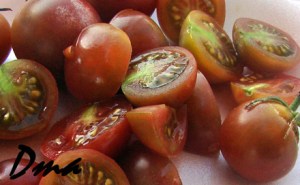
No matter what size garden one tends everyone gets hyped up about growing sweet, juicy tomatoes. To honor this megastar, Amador County Master Gardeners conducted their 18th Annual Tomato Tasting Contest at the Farmers Market in Sutter Creek. The competition was open to anybody, experienced and first-time gardeners, and Mom and Pop farmers.
This year, the event brought in 100 entries! Hybrid or heirloom, variety (over 60) didn’t matter. This competition is all about flavor.
Tomatoes were divided into three categories, full size non-red, full size red, and cherry. Each entry was logged, tagged, categorized, and cut into bite-size pieces. Participants looked on with anticipation while three poker-faced judges tasted and scored each entry.
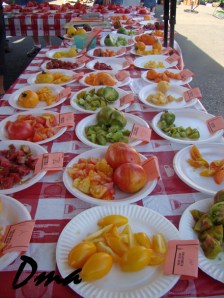
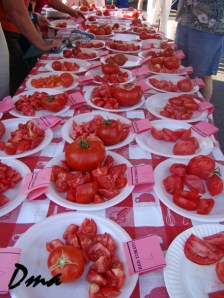
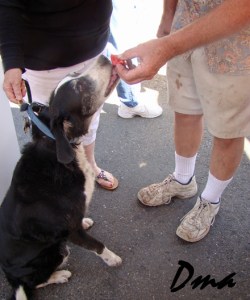
Once the winners were announced, the public was free to sample red, yellow, orange, green, and plum colored tomatoes. Adults, children, and a few canines enjoyed the chance to experience the many varieties. Attending a tomato tasting contest is sure to get you hyped up for next year’s crop.
Here are the Judges’ Results:
Full size red:
1st Place, Early Wonder
2nd Place, Abraham Lincoln
3rd Place, Big Beef
Full size non-red:
1st Place, Black Krim
2nd Place, Golden Girl
3rd Place, Yellow Jubilee
Cherry:
1st, 2nd, 3th Place, Sun Gold
My Toad has a Name:
The poles are in and I’ve chosen the name Tobi the Toad, submitted by Dolores. Thanks everybody for your suggestions. I got a kick out of each. Valerie, what a good question: “Can a toad be a she?” The word ‘toad’ certainly does sound masculine. But the term is not gender related. In fact, “Toad is a mystery word, with no known relatives in any other Indo-European language.”
Female toads deserve a better appellation as they lay between 1,000 and 5,000 eggs in a single clutch. Regardless of the toad’s sex, always handle with caution (we didn’t know this), and stop pets from putting them in their mouths. If a toad becomes frightened, it can ooze a poisonous milky juice from the skin glands. This poison has been known to kill pets and wildlife, so wash your hands thoroughly after handling one, and never put your hands near your eyes or in your mouth. Probably best to simply enjoy watching toads.
September is here:
September events are now posted (click on “Events’ on sidebar), full of nature and garden related activities many of them FREE. Tours, workshops, festivals, clinics! Take advantage and make this the month to go out and have some fun before winter arrives.
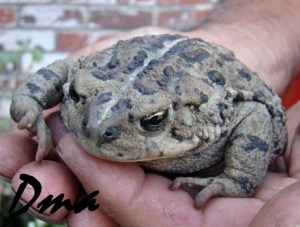
Some men give flowers or chocolates to their sweethearts. I received a toad!
I can’t complain though. Toads are beneficial in the garden. They consume thousands of harmful insects in one summer, some of which include slugs, snails, beetle larvae, cutworms, and much more. This toad (help me come up with a name) looks like he or she likes to eat – a living, thriving gift that will defend my garden.
Occasionally, I do receive flowers. And like the flowers, when this gift was presented I also received a kiss – from the prince not the toad! Now that’s a good fairytale. Don’t you think?
Crown:
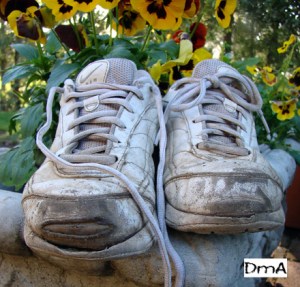
The plant crown is where the stem meets the roots. Most crowns are planted at soil level or a little above ground level. Burying the crown below the soil can lead to rot and eventually kill the plant.
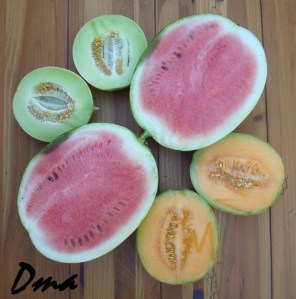 My family has consumed the last of the homegrown, sweet melons and tender potatoes. Also gone from my garden are the green beans, crookneck squash, lettuce, and cucumber plants. The zucchini and tomatoes linger on and so is the self-satisfaction that comes from cultivating vegetables.
There are many benefits to growing your own food, from goal setting to putting an extra buck in your pocketbook—something we all need these days—from bragging rights of flavorful, chemical-free meals to educating children.
Growing your own produce gives one something to look forward during difficult times. For sure, this winter I’ll miss the savings at the grocery store’s checkout counter, an estimated $50 per week. Like so many families, it hasn’t been easy stretching a budget on part-time work, wage and benefit cuts, increasing medical costs and raising food prices. Because of high-prices, many families are understandably making unhealthy choices. Let’s face it, healthy cuisine (especially organic) can cost more than cheaper processed food. However, when life gets tough it’s even more important to stay fit, physically and mentally.
Dani Federico, M.P.H. Masters of Public Health, UC Berkeley, personal trainer, nutritional counselor, and health blogger says, “Gardening can be a great stress reliever (even if you feel like some gardening flops have caused you some stress!). Spending time outside improves health by allowing us to breathe fresh air while the sun provides you with Vitamin D. Being responsible for another living thing gives us a sense of purpose which improves our overall happiness. While gardening is not vigorous enough to count as your exercise for the day, it is a great way to lead an active lifestyle.”
The tastes of homegrown flavors alone are enough to improve one’s health and habits. “I grow many vegetables because you can’t buy the flavor and freshness in any store,” says Master Gardener Glen Johnson. “As a result, we eat far more vegetables in our meals.”
Mike Spinetta, Staff Writer for The Gold Country Times, says he grows vegetables to “teach his daughter about how life works.” “Even this year, we planted tomatoes for some silly reason, and she sees how the plants are bearing no fruit. Aside from teaching her, it’s great to trade what fruit, veggies, and herbs I get for my neighbors’ various home crops.”
For those who garden, the reasons are as vast as vegetable varieties. Regardless of any “garden flops,” cultivating one’s own food brings a great deal of satisfaction to the soul. Vegetable gardening is a rich and varied experience that grows deeper than tomato roots while producing a healthier body and mind. © 2011 Dianne Marie Andre
PS: If you’ve been thinking about growing your own vegetables, autumn is the perfect time to begin. Whether you’re a novice, you want to switch to raised beds, or you’ve relocated, I can help you get started. For consultation information, please contact Dianne at inthegarden@softcom.net.
Canker:
A bacterial or fungal disease on woody plants. Gradual death will occur in the cambium layer leaving sunken bark lesions.
I squatted down to look at what I thought were baby spiders jumping on the ground. Leaning in closer, I realized they didn’t have legs but instead appeared to be teeny seeds, a much smaller version of Mexican Jumping Beans. There were so many it sounded as if dew was drizzling all around me.
Afraid to touch them, I stood up and hollered at my husband, Joe, to come see. We squatted together, shoulder-to-shoulder, and watched dozens of them jumping in the perennial beds and on the slate steps where we hunkered down.
Joe touched a few and decided they were indeed seeds. I felt one with my index finger. It was as hard as a rock.
“I think it’s the heat that’s making them jump,” Joe said.
“It’s not that hot,” I replied as we both felt the slate step.”
I looked up into the oak tree above us. They couldn’t possibly be falling from the oak. Oak trees germinate from acorns, not seeds. But where are they coming from? Later that evening, sitting in front of my computer I typed in the only phrase I could think to Google: Tiny jumping seeds. Surprisingly, there were several informational websites.
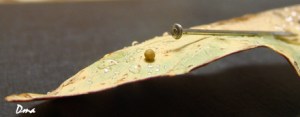
The seeds are actually Jumping Oak Galls also known as California Jumping Galls. Cynipid, non-stinging wasps (Neuroterus spp.) lay their eggs on the underside of leaves. Plant tissues develop, creating a protective gall around the lava. The jumping galls are only 1/25th of an inch in diameter, the head size of an old-fashioned straight pin. The larva moving within the gall causes the jumping.
California Jumping Galls usually drop by late summer to early fall and are considered harmless to trees. Metamorphosis changes the larva into a pupa which overwinters within the gall until spring. The emerging wasps are tiny, shiny black females, so small it’s unlikely anybody would see them. They lay eggs on oak shoots without male fertilization. The following generation is bisexual, winged males and females. Amazing! The reproductive cycle mysteriously continues. But who knows which generation of wasps will hatch in my garden, all females or bisexuals.
Nature never ceases to astound or entertain me. Teeny, jumping galls beneath the oak, making music that simulates drizzling dew, is one of many fascinating treasures. © 2011 Dianne Marie Andre
You are currently browsing the archives for the Dianne's Blog category.


 | Aimee E on Slanted Light |
 | Anonymous on A Lesson in Forced Blub F… |
 | Corinne W on I have Argyranthemum Frut… |
 | Dianne Marie Andre on How to Deadhead Snapdrago… |
| Anonymous on How to Deadhead Snapdrago… |

 In and Around the Garden