Archive for the ‘Dianne's Blog’ Category

h1

Summer Colors

July 27, 2010

Here are a few of my favorite flowers blooming in and around my garden this summer.

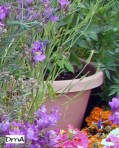
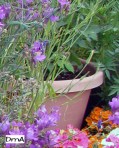
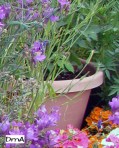
The flowers in the photo above include Salvia Blue, yellow Festival Gerbera Daisies, and pink Pentas. They rise from a small rectangle concrete planter outside a floor-to-ceiling window. Every season I fill the planter with colorful annuals, easily seen from inside the house. Normally, I choose flowers with a matching color in the petal or center. I have to say, I like the combination, especially the pop of yellow.
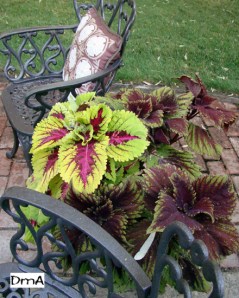
In my back patio, Coleus (Solenostemon scutellarioides) adds a mix of leaf pattern and color. No need for anything else as it would be too busy. A shade-loving annual, mine, however, gets part-afternoon sun. Even on triple digit days, it does well as long as I keep it watered.
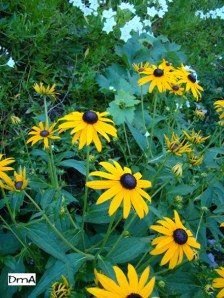
Above, in the perennial garden, a volunteer grapevine has popped up between the potato vines and the Black-Eyed Susan (Rudbeckia fulgida), also a volunteer. It will be interesting to see what type of grapevine this is, and if it will produce.

 

On the other side of the garden is another Black-Eyed Susan with yellow centers (above). Purchased last year at Lowe’s, I asked the nurseryman for the plant’s name. (I hate it when there’s no label.) He said, “It’s a new Black-Eyed Susan but with a yellow center.” Hoping to find a label, I looked for them this year in several nurseries. No luck. I searched the internet for information. No luck. Maybe it didn’t go over so well. Unlike its sister, the stems aren’t strong enough to hold up the flower heads, so staking is required.

Tomorrow, I’ll share an oversized plant and veggie you won’t want to miss.

h1

Budding Garden Thoughts

July 26, 2010

MyFreeCopyright.com Registered & Protected


 “Cucumber sandwiches

and lemon iced tea

beckon friends

to sit in the garden with me.”

Copyright © 2010 Dianne Marie Andre


h1

Contest Update

July 22, 2010

Things are steaming up with the FIRST EVER, BOOK-GIVEAWAY contest. There’s still time to get in on the fun, or keep going if you’re already participating. 

Here’s a recap of the contest prize and rules: 

THE PRIZE:  My mint-conditioned copy (autographed to me) of The Earth MovedOn the Remarkable Achievements of Earthworms by Amy Stewart. Amy Stewart is a regular contributor to the San Francisco Chronicle, Bird Watcher’s Digest, and Organic Gardening, and the author of From the Ground Up, Flower Confidential, and Wicked Plants

New Announcement:  Amy Stewart has a new book coming out in 2011, Wicked Bugs, so now is a good time to start collecting her ever-popular books for your library. 

Here’s how you can win

  1. You must be a subscriber to play, so be sure to sign up. It’s FREE!
  2. Get 5 or more of your friends, family members, and co-workers to subscribe to inandaroundthegarden.net. To qualify, you must sign up a minimum of 5 new subscribers. Be sure to tell everyone that it’s FREE.
  3. Entries will close July 28, 2010 midnight.
  4. After all of your friends have subscribed, email a list to me at, inthegarden@softcom.net.
  5. After the deadline, I’ll verify that each person is, in fact, a new subscriber.
  6. The person who has signed up the most subscribers is the winner. In the event of a tie, I will draw one name.
  7. The winner will be notified by email. The winner’s name will be announced on inandaroundthegarden.net.

Questions? Email:  inthegarden@softcom.net with Contest in the subject line.

h1

Budding Garden Thoughts

July 21, 2010

MyFreeCopyright.com Registered & Protected


“When heart and nature

work jointly, the harvest swells.”

Copyright © 2010 Dianne Marie Andre

h1

Summer Dinner

July 20, 2010

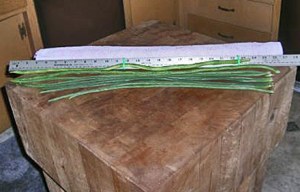
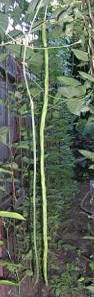
Homegrown produce, fresh off the vine, brings magic to the dinner table. Authentic flavors and aromatic scents heighten engaging conversations in ways store-bought food can’t. Serving a meal grown with your own hands is one of the best symbols of hospitality. Recently one of my readers treated friends to such an occasion. Below, with Betty Lee’s permission, I’m happy to share the special event. Here’s what Betty wrote.

“We had our first long-bean dinner last Friday, greeted with great anticipation. Our fresh garden vegetable dinner included baby bok choy, Japanese cucumbers, Mortgage Lifter and Celebrity tomatoes, zucchini, eggplants, bell pepper, and cilantro to complement the crab, pork spareribs, chicken, and won ton soup. Afterwards, my guests went outside to see my 2010-prize bean. It was 32 ½” long, and still growing. I am keeping this one for seed. 

The guests went home with some tomatoes, eggplants, and a variety of basil.”


Photos courtesy of Betty Lee. 

h1

Budding Garden Thoughts

July 14, 2010

MyFreeCopyright.com Registered & Protected


“Fertilize the soul

with adequate nourishment: 

Surround yourself with encouragers and doers.”

Copyright © 2010 Dianne Marie Andre

h1

What’s up in My Garden

July 13, 2010

Let’s start a thread of comments about “what’s up in my garden.”

I’ll spin the first thread:

My vegetable garden, as I mentioned before, is a single raised bed built by my husband, Joe. He was going to fill it with soil from the pasture but I didn’t want to rob top soil from the old area for the new bed. I should have listened to him.

The raised bed’s soil came from an outside source. Who knows what was in it. I’ve lost a whole crop of lettuce and now two more problems have attacked my plants. For years, I had a huge vegetable garden growing in the warm earth (not a raised bed). The only problem in the old garden was hornworms.

Problem #1:  My Mortgage Lift heirloom tomato plant has Tobacco Streak. The virus arrives by Thrips through pollination. The leaves curl under and brown streaks run along the stems. I’ve trimmed off much of the infected parts, but the disease remains deep within the plants fiber. The tomatoes may or may not develop necrotic ringspots and lead to flower drop. At this point, all I can do is wait and watch.

Problem #2:  Ants have invaded my zucchini blossoms. Ants love sap; we all know this from their drunken parties with sugar in the pantry, chocolate cake on the counter, a breakfast plate in the sink still holding pancake syrup. In the garden, ants are usually a sign of aphids, but this is not the case with my zucchini plant. The ants are after the nectar, and there’s plenty in the depths of yellow zucchini blossoms. If left untreated, the ants can steal all the pollen and cause the blossoms to drop.
Because I don’t want chemicals around my plants or food, or seeping into the soil, I’m experimenting with corn meal. Supposedly, ants can’t digest the meal and die.

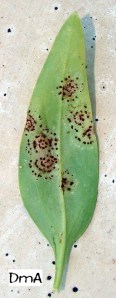
Problem #3:  In the perennial garden, my snapdragons have Downy Mildew. I’ve posted a photo so you’ll know how to identify it in your garden. Mildew is common on snapdragons, and most of mine get it every year. Unless it’s necessary, I’m not one to spend money on products. The snapdragons have finished blooming, and are littering seeds for next spring’s generation. Eventually, as the mildew spreads and turns the plant ugly or threatens to infect neighbors I’ll pull up the plant.
Now, it’s your turn to spin the next thread of “what’s up in my garden.”

h1

Ten Garden Tips for Avoiding Aches and Pains

July 12, 2010

MyFreeCopyright.com Registered & Protected


1.  Dress the part. Wear comfortable closed shoes with cotton socks. Clogs may be easy to slip into and out of, but your feet are apt to do just that, causing loss of balance and possible injury. Avoid sunburn. Use sun block. Wear sunglasses and a wide-rimmed hat that will shade your face and neck. To protect your body from a variety of elements like thorns and bacteria in the soil, wear garden gloves, long sleeves and pants. Even if you don’t have bad knees, use kneepads or a knee cushion.

2.  Take a few minutes to stretch your legs, arms, neck, and back. Your body will be more flexible and less apt to hurt later.

3.  Use tools that fit you. If a clipper opens too wide for your hand to manage comfortably, your hand will have to work harder. The same goes for large tools like shovels and rakes. If they’re too heavy, it will take more energy and effort to maneuver.

4.  Keep tools in tip-top shape. No point in struggling unnecessarily with dull blades. Keep them sharp and oiled so your tools do most of the hard work.

5.  Don’t stay kneeling or bent over for long periods. Switch off and on doing different garden tasks.

6.  Wear a mask and gloves while handling chemicals.

7.  Avoid dehydration. Stop to drink water every 30 – 60 minutes.

8.  Avoid tripping or stepping on garden tools by putting them away after each use.

9.  Lift heavy items with your legs, not your back. Use a dolly to move heavy pots and bags.

10.  Rejuvenate your body with a warm bath. Soak in Epson salts and scented herbs from your garden.

Copyright © 2010 Dianne Marie Andre

h1

Budding Garden Thought

July 9, 2010

MyFreeCopyright.com Registered & Protected 

Sow necessity with gratitude: 

Do one mundane task

with a new attitude and

watch your day improve.”

Copyright © 2010 Dianne Marie Andre

h1

Guide to Mildew Disease in the Garden

July 8, 2010

Q:  My cucumber plants continue to have problems with mildew. I don’t want to spray anything on them; but if the problem persists, it might kill the plants or shorten its life.  Any solution?

A:  There are two types of mildew. Powdery mildew and Downy mildew. Powdery mildew is a light-colored powder on shoots and on both sides of leaves, and sometimes flowers. Usually appears first as yellow spots on upper leaf surface of older leaves. Powdery mildew is carried by wind, and thrives in warm weather. Moderate temperatures and shady conditions will work in the disease’s favor. Make sure your plant receives enough water. Avoid excess fertilizer. When there is a limited amount of powdery mildew, trim and bury or discard of diseased foliage as soon as it appears. Downy mildew produces yellow to brown and/or fuzzy spores mostly on the backside of leaves after rain or heavy dew, and disappear soon after sunny weather resumes. Downy mildew thrives in cool weather. For this type of mildew, let the ground dry between irrigations, and keep leaves dry. Make sure the plant has good air circulation.

Possible Solutions: You can try an organic product on the market. Check with a professional nurseryperson for the most effective product available in your county. Although some gardeners use 5-percent solution of baking soda (1 teaspoon to 1 quart or 1 liter water), this did not work on my snapdragons. However, my snapdragons were heavily infected.