We’re on Twitter!
Join us at www.twitter.com/dianneandre
and start twittering!



By Bernadine Chapman-Cruz
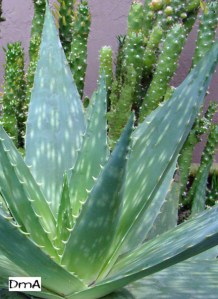 I’ve never had a green thumb with houseplants. They invariably droop, shrivel, turn brown and die. My small outdoor garden hosting palms and ferns has fared somewhat better. However, the shining star of my gardening efforts is my cactus and succulent garden, hosting over 75 in-ground and potted plants.
In the beginning, I thought cacti needed sandy soil and lots of sun and water to prosper. Enthusiastic in my new venture, I faithfully watered my cacti every day during the heat of summer, only cutting back in winter. I watered my cacti just like God intended, with rain falling from the heavens. Following this template, I poised my hose directly above each cactus plant, letting a mini-rainstorm pour down on top of my cacti until the ground was saturated. But soon, my cactus plants were going the way of my house plants – beginning to die off.
One day, in the gardening section of a local home improvement store while looking for replacements for my cactus casualties, another shopper approached. I watched as she quickly made her selections from the display of healthy plants, a sharp contrast to what my cactus garden had become.
“What are you going to get?” she asked.
“I’m not sure,” I replied. “I really don’t know anything about cactus. Some of my plants are dying, so I need to get some new ones.”
“Have you ever been to Poots House of Cactus?” she asked.
“No,” I said.
“That’s where you need to go, because they know all about cactus, have a large selection to choose from and even have a cactus club.”
A few days later, I decided to check out Poots House of Cactus on Highway 120 in Ripon. When I pulled into the parking lot, the grounds were alive with cactus of every shape and size. There were big cacti, small cacti, tall cacti and short round spiky cacti on every inch of ground. There were also several long tables laden with potted cacti and succulents, each sporting a yellow price tag with plant identification.
First, I browsed the tables, then ventured into the hot house where I met owners, Bill and Roelyn Poot. A delightful couple, the Poots’ expertise in cacti and succulents is unequaled, having been in business for 20 years. They freely shared their knowledge and invited me to join the Stockton Cactus & Succulent Club.
With a friendly wave, I left with a bevy of plants, some cactus potting soil, and invaluable information on watering my cacti. My dying cacti were afflicted with overwatering. I had been drowning my plants, which only needed deep ground watering twice a month in the summer, and no water after October.
Today, some six months later, my cactus garden is thriving. I followed the Poots’ advice on watering, moved my potted plants to a sheltered area and covered my in-ground plants to protect them from frost – a cactus and succulent killer.
Thanks to Poots House of Cactus and the Stockton Cactus & Succulent Club, my cactus garden has survived and is thriving. Copyright © 2011 Bernadine Chapman-Cruz
For more information on cacti and succulents and cactus club membership contact Poots House of Cactus, 17229 E. Highway 120, Ripon, CA Open Monday – Saturday 9-5 Closed Sunday or call (209) 599-7241 or email pootscactus@yahoo.com and say Bernadine sent you.
About our Guest Writer: Bernadine Chapman-Cruz lives in Northern California with her husband George, where she writes and grows cacti. She has been a professional freelance writer with over 600 articles appearing in a variety of local and national publications over the past 20 years. Bernadine’s current assignment is writing the Biz Buzz section for Lodi Monthly Magazine.
Writing is my passion,” Bernadine says. “I will write about anything, anywhere, anytime.”
In addition to writing fiction and non-fiction material, Bernadine has reviewed books on Amazon.com as well as reviewed movies. Bernadine also edits for other writers. “Editing is a new aspect in my wonderful world of writing,” she says, “and something I find very fulfilling helping other writers improve their work.”
In and Around the Garden is Bernadine’s first guest blog assignment.

Annual:
Plants that complete their life cycle in one growing season.
Biennial:
Plants that live for two years, producing flowers and/or fruit in their second year from seed.
Perennial:
Plants that live for more than one growing season, three years or more under normal conditions.
Note: If you received Part II first and you’re wondering where’s Part I, I just noticed that I forgot to post it yesterday. That’s what happens when I leave the house early.
 If the elusive-growing season hasn’t steered your thoughts forward spring planting, browsing seed catalogs is sure to germinate enthusiasm. Cozy next to a warm fire, a hot beverage and a few catalogs and you’ll start counting the days for putting down seeds. Studying seed catalogs is a romantic occasion, when your mind fills with visions of mouth-watering produce and colorful flowers. Their scents seem to float from the photos and descriptive text as the tiny seeds considered become subject to ordering. If you haven’t experienced delirious moments while under the spell of seed catalogs, and you’re new to seed shopping, via catalog, order copies now for February planting.
Even if you don’t have space to jump-start your spring plantings with indoor sowing, or you simply prefer six-packs to seeds, there are several benefits (besides romance) for reading seed catalogs. Here are a few advantages:
Most seed catalogs are available on the web to browse, buy, and order a free catalog. However, some companies no longer mail printed catalogs. If you know beforehand what seeds you want to purchase online buying saves time and gas. But nothing beats the hand-held catalog. Copyright © 2011 Dianne Marie Andre
Tomorrow, look for Part II with tips on choosing the right catalogs and seed ordering hints.
Here are more tips to help make your seed selections successful.
When your seed order arrives, check the contents against the packing slip. After planting, staple each seed envelope to a blank sheet of paper for writing notations. Note things like:
Tuck your notes in the proper catalog for future reference. These steps may seem like overkill. However, they’ll save time. After a few seasons you’ll know which companies you favor, varieties the whole family loves, and how much to order.
Please add your own comments about seed catalogs. We’d love to hear your comments and experiences.
Every Friday for the past year, I have shared poetic verses and spiritual inspirations called “Budding Garden Thoughts.” This year, I’m excited to announce “Soulful Plotting” in its place. This too will be short and simple, but will address garden terminology as a useful glossary of garden related information.
Look for “Soulful Plotting” (and the photo of my garden shoes) beginning Friday, January 7.

Thank you for your support this past year.
Please note: What I write in this space are lessons learned through trial and error, research, and from other gardeners and professionals. I garden in zone 9, but share garden experiences that I believe are relevant to most zones within a reasonable time frame and planting conditions.
January
Maintenance: If your soil isn’t too wet, remove weeds with roots in tact.
Control slugs and snails. Clearing away leaf piles, and unused pots and saucers will help eliminate breeding zones.
Listen to the weather reports for frost, and protect sensitive plants when the temperature drops below 32 degrees.
Clean rain gutters.
If you’re a seed catalog shopper, start making your selections for February planting.
In the vegetable garden: Plant bare-root strawberries, raspberries, blackberries, boysenberries, asparagus, artichokes, rhubarb, and horseradish. Plant seedlings of Bok coy, lettuce, spinach, parsley, onion, white potatoes, broccoli, cabbage, chard, cauliflower. Sow seeds of fava beans, lettuce, parsley, mustard, peas, carrots, beets, and radishes. Indoors, sow tomato, pepper, and cauliflower, cabbage, and broccoli seeds.
For spring production, fertilize asparagus and rhubarb with cured manure.
Spray fruit trees with dormant spray after the leaves have fallen off, before new buds form. Spray peach trees for Peach-leaf Curl. Also, spray around the ground of tree trunks to kill any hidden spores.
In the landscape: There’s still time to plant bare-root roses.
January is a good time to shop for evergreen shrubs like camellias, rhododendrons, and azaleas. Plant color spots of violas, pansies, and gladioli corms every three weeks for continuous spring blooms.
Prune roses, deciduous fruit trees and most other deciduous shrubs. Wait on spring-blooming trees and shrubs after they are done flowering.
Divide overgrown plants such as Canna, Gerberas, mums, ornamental grasses, Shasta daisies, daylilies, yarrows, and more. Copyright © 2010 Dianne Marie Andre

Walking in and around my garden this morning, here’s what I noticed on the first day of 2011:
Splash . . . it’s raining again.
My hydrangea has buds.
Trick or treat . . . I still have a pumpkin on the front porch.
It’s no longer pitch-black at 5:00 p.m. . . . actually, I noticed this a few nights ago.
Hate it when this happens . . . every shallot planted in one section of the garden has disappeared.
Surprise-surprise . . . there’s a dozen Alpacas in the neighbor’s field, next to my chicken pasture.
Well, blow me down . . . the one-trillion leaves in the perennial garden don’t have a clue how to drift onto the neighbor’s property.
For the first time in a long while . . . I read these words on the my blackboard:
What have you noticed in the New Year?
Journal entry December 17, 2010: The leaves of five weeping willows, now bright yellow, still cling to stems in the sweep of long, hanging boughs. This is where Ralphie and I run too when gray days become too depressing and I need sunlight. The trees, in the last stage of dormancy, can’t infect me with a dose of vitamin B, but the golden park lifts my spirit, and Ralphie . . . well, he’s just happy to run around outdoors, nose to the ground. 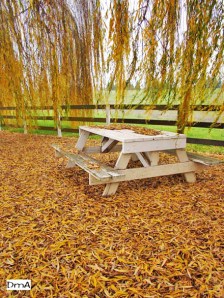
My husband and I have made it a practice to keep the Willow Grove natural. As a result, there’s a good twelve inches of leaf mulch on the ground. This is one place we don’t have to hoe or spray weeds. It doesn’t take long for the fallen leaves to change. By the end of December, before the New Year begins, they’ll turn into a brown mat.
It rained last night, so I stand beneath the stringy willow skirts on a leafy sponge. Ralphie’s shaggy legs are wet and no longer white as he runs after a phoebe on the fence post. Smells of decay, mud, and moss rush together. The air is damp; pasture green, the sky a dull statue gray.
Having lived here for years, I know this scene well, how nature binds together layer-upon-layer in 3-D. I study however many details my eyes will allow me to discover: fence boards spackled with rust and moss, old manure spreader rims partly buried in leaves, a tiny mushroom peering out from the thick soggy sponge-of-a-ground, and an old willow stump that Ralphie just leaped from, awkwardly dragging a twig alongside his short frame. Ralphie brings the twig to me, tail twitching. Then he runs away. I chase after him because that’s how we play before I grow breathless and call timeout.
The willows take their own timeout. Soon the golden park will be brown. Skinny, dead boughs will drop and land willy-nilly, many like hand-stitched Xs on a crazy quilt. Once this happens, on days when the sky is gray, Ralphie and I will run to the backyard. Here, Chinese maple leaves dot the lawn and patio with bright yellow leaves. The surface isn’t a spongy mat though. When the grass isn’t too wet, my husband trims the lawn sucking up sunny-colored leaves. Between maintenance, more will drop. Well into the New Year, there’ll be a bright spot to lift my spirit. It will be a good year. Copyright © 2010 Dianne Marie Andre
Thank you for letting me share my world with you in 2010. I hope your year, in 2011, is filled with all things grand and special.
After the holidays, it’s best to remove your Christmas tree from your house as early as possible. Never burn your tree in the fireplace or outside. Christmas trees ignite rapidly, pop, spark, and can cause a fire and the loss of homes or worse, lives.
If you have a mulching machine, or you plan to rent one, get the job done right away. Dry Christmas trees are just as dangerous when left outdoors.
Most towns offer curbside pickup after Christmas. Contact your municipal office by telephone or Google their website for information on proper disposal, pickup schedules, or locations of the nearest drop-off recycling center. Nonprofit organizations, such as The Boy Scouts, also offer pickup service for a small donation fee.


 | Aimee E on Slanted Light |
 | Anonymous on A Lesson in Forced Blub F… |
 | Corinne W on I have Argyranthemum Frut… |
 | Dianne Marie Andre on How to Deadhead Snapdrago… |
| Anonymous on How to Deadhead Snapdrago… |

 In and Around the Garden