 “I count it a blessing
to care for all things green
. . . and a miracle that they live.”
Copyright © 2010 Dianne Marie Andre

“I count it a blessing
to care for all things green
. . . and a miracle that they live.”
Copyright © 2010 Dianne Marie Andre

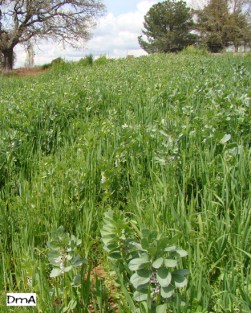 A recent visit to Metzger Farms knocked my ideals about meticulous gardens down a notch or two. Randy Metzger, retired county assessor, and his wife Susan have lived on their ten-acre farm in the Sierra foothills since 1978. Fruit trees, vineyards, gardens, a pond, and outbuildings circle the couple’s log cabin home.
Randy has been gardening since 1951. His newest garden lot, secured from deer by a ten-foot high fence, lies north of the cabin, tucked out of view. Inside the fence, the grounds look like an unkempt prairie of weeds. I’m talking, thick growth three-foot high. However, what seemed out of control are actually cover crops. Tucked among them were some of last season’s overgrown cauliflower and cabbage. There were probably other vegetable varieties, but they were difficult to spot among the cover crops.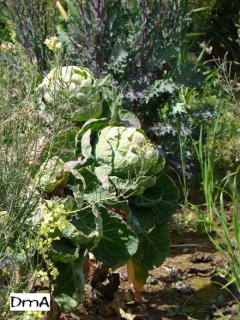
A gardener of medium to high standards would have dispelled a frown across the muddle swell. Much as I love gardens for their beauty (and fresh flavors), a recent horticulture class on cover crops gave me a sense of appreciation for what was actually happening in Randy’s garden. This feeling was liberating. It told me that something good and wonderful was taking place. Life was regenerating itself in a natural and healthy way. No chemicals. Whatever nutrients last season’s vegetation sucked from the soil was going back into it. The incoming plants would flourish.
“You can tell how good your soil is by how the cover crop looks,” Randy said, pointing to a lush area then to a dwarfed one. Cover crops improve the soil’s health and structure, naturally. They prevent erosion and can choke out weeds. Leguminous cover crops add nitrogen.
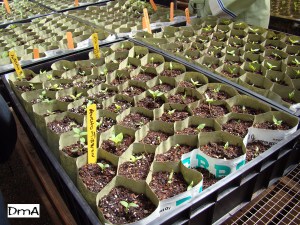
Randy also leaves some of last season’s vegetable stocks in tact. Many were dead . . . brown woody-debris-dead. Get them out-of-here, they’re ugly dead. Others were living, giant monstrosities with flower stocks shooting up, going to seed. About a month before planting new vegetables, Randy mows and tills everything into the earth to decompose and to amend the soil with organic matter. This is what professional horticulturists do . . . care for the soil first, before they plant. Randy sows everything from seed in his little greenhouse, and then sells his vegetables, fruits, cider (as well as plants), June through Thanksgiving.
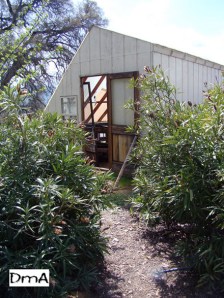 Most likely, there’ll be a cover crop growing in my garden this winter. Copyright © 2010 Dianne Marie Andre
 “Seasons assure us of life’s unending cycles.
Learn from them . . .
and love to learn.”
Copyright © 2010 Dianne Marie Andre
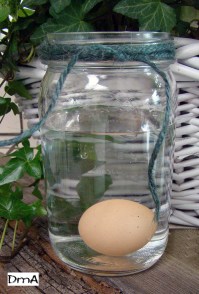
Ten Tips and Truths about Eggs:
1. Egg size is determined by weight per dozen.
2. Grade is determined by the quality of the shell, white, yolk, and the size of the air cell.
3. Stored in refrigerator, eggs can last up to three weeks
4. Keep eggs separate from strong scented foods (fish, onion, garlic, melons, etc.) as they absorb odors.
5. You can tell if an egg is fresh when the yolk, and the white next to the yolk, stands up tall.
6. Rotten eggs will float to the top when placed in a bowl of water; unspoiled eggs will sink.
7. To tell if an egg is raw or hard-cooked, spin it. A hard-cooked egg will easily spin. A raw egg will wobble.
8. The white meat spot is not sperm or an embryo. It’s what anchors the yolk in the center of the white.
9. The blood spot sometimes seen in an egg is a blood vessel that ruptured during formation. It is not an embryo.
10. Cloudy egg whites are caused by one of the following: 1)carbon dioxide in the white; 2)the protein that holds the yolk together is stronger than usual causing a cloudy appearance; 3)the egg was stored between 32 and 39 degrees F.
Whether you celebrate Easter or not, I sincerely hope that something wonderful and special will come your way today. Dianne Marie Andre
 “Painted Easter eggs and giggling children
remind us to celebrate the rising Son.”
Copyright © 2010 Dianne Marie Andre
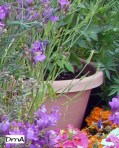 “No occupation is so fulfilling as birthing a seed,
a bud, or your own nourishment.”
Copyright © 2010 Dianne Marie Andre
Yippee . . . Betty’s generosity has spread. Yesterday, a delivery of free topsoil came . . . a surprise that I knew nothing about. This afternoon, free irises were offered to me. I hope–and I truly mean this–that you all receive just as many or more blessings.
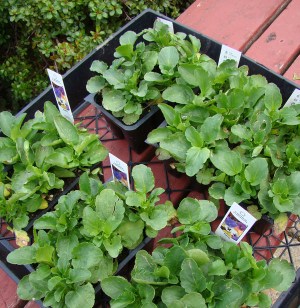 Thanks to one of my faithful readers, Betty Lee, I was able to enjoy my favorite garden task . . . planting, which is probably why I slept so well last night.
Like many people, the broken economy has entered my household. I’ve made major cutbacks, including the indulgence of a few annuals. Plans to replace the perennials removed west of the oak tree are on hold. (Read Acorn Blues about this change.) Here’s the miserable thing about doing away with planting . . . I love to plant. I don’t “have” to place anything into the ground or pots. It’s not a necessity, but it is something that gives me a great deal of joy.
Occasionally, I hear about someone who wants to cut back on their yard work and ends up throwing out plants or pots because they can’t find a taker. Therefore, I decided to find a giver. Many of the subscribers, who received In and Around the Garden when it was an e-newsletter, live nearby. Without explanation, I emailed them asking if they had x-large pots (one of mine broke), topsoil, single-trunk dwarf plants, or Japanese Maple trees that they wanted to get rid of, and if so to please contact me.
Betty’s reply gave me hope.
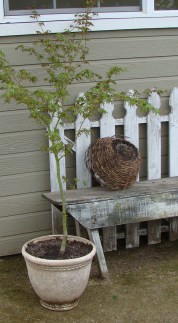
Betty has lived in the same house for 40 years, and tends the lawns, and trees and shrubs all by herself, potting up every little shoot that reseeds from other plants or carried in by birds or wind. The front and back yards are neat and tidy with seasonal color spots. Betty led me through the side yard, and instructed me to grab the upright wheelbarrow leaning against the fence. Following behind her, I pushed it to a southeast corner. I expected a seedling (the wheelbarrow should have been a clue), so imagine my surprise when Betty pointed to a five-foot Japanese Maple tree! The tree was mine—all mine—to take home and plant! It nearly took my breath away. A tree this size would cost $50 to $70! How blessed am I?
Pushing the full wheelbarrow to the car, Betty asked me to stop. She reached down, picked up some pansies, and said these are for you. I was beaming . . . squealing inside . . . grateful to have met up with such a generous lady. Thank you, Betty Lee!
Maybe planting had nothing to do with a good night’s sleep.
Copyright © 2010 Dianne Marie Andre
This month, in the post office box, was a copy of the March/April issue of Victoria magazine. Inside the slick pages, an article on Old Florida holds beautiful pictures of their Central Park. In the days when my husband, Joe, and I had vacation benefits, once in awhile we would take a trip. On these occasions, garden tours and beautifully landscaped accommodations were my favorite sights. Joe gravitated toward architecture and studying framework (he’s a framer) behind amazing structures.
Whenever possible, during weekend getaways we stayed at a bed and breakfast. They are quaint and homey and provide delicious breakfasts (for Joe), with simple yet elegant gardens (for me). Looking at the pictures and reading the articles in Victoria magazine remind me of those trips. Turning the page of the Old Florida article, I now dream of visiting Thuya Garden in Maine. No speck of soil appears as layer upon layers of lilies, salvia, phlox, dahlias, Malva, astilbe, and much more rise above the earth. Numerous flower shapes in shades of purples, reds, whites, yellows, pinks, and fuchsias drizzle on the pages from edge to edge. I want to be there!
While in Maine, I would go to Blackrock Farm (featured on the following pages) where one couple live off the land by sharing their abundance. Guests are free to roam among annuals and perennials, vegetable plots, and greenhouses. I would take one of the workshops offered, fill my camera with landscape ideas, and bring home a plant or two. Joe would eat!
There was a time when I wanted to be a travel writer. The road, however, took me in another direction. I’m content with the route. Still, if the opportunity came along, I would steer a bit to the right and head for a few travel assignments each year. Until then, I am happy to travel through magazines like Victoria where I can experience treasured gardens and flowers galore. Copyright © 2010 Dianne Marie Andre
Is there anyone out there who’s been fortunate enough to have visited these places?
As sure as nuts fall from trees, inflecting elements push landscapes, and gardeners, to visit new possibilities. To read Acorn Blues, click on Country Buzz.
You are currently browsing the archives for the Dianne's Blog category.


 | Aimee E on Slanted Light |
 | Anonymous on A Lesson in Forced Blub F… |
 | Corinne W on I have Argyranthemum Frut… |
 | Dianne Marie Andre on How to Deadhead Snapdrago… |
| Anonymous on How to Deadhead Snapdrago… |

 In and Around the Garden