h1

Garden Update

September 10, 2010

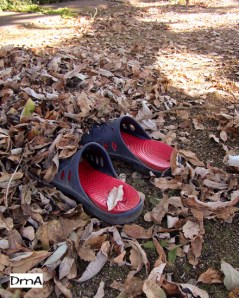
In my perennial garden:  These days, I’m walking on a carpet of leaves. As I look underfoot and then across the garden grounds, my shoulders droop with dread. Then, what isn’t visible among the dry leaves changes my mood. No acorns. Hallelujah. Joy comes back to me. The acorn factory has closed. The factory will fire up again—without a doubt—once the cycle makes a complete turnabout in five to seven years. Until then, instead of 10-zillion h-e-a-v-y leaf bags each fall, I’ll rake and fill 5-zillion light leaf bags. Most importantly, I won’t have to extract a carpet of seedlings.

The second of two round shrubs, on either side of the garden’s entrance, has killed over. Each area now needs new plants, preferably draught-tolerant. At this time, I have no idea what. This will be a good winter project to research. The zinnias are holding up, still blooming. The vincas aren’t fairing as well—which is unusual—so I pulled most of them up this morning. Normally, they are stunning until the first frost.

The crepe myrtle has aphids. No surprise. They are famous for aphids.

In my vegetable bed:  Little-by-little, summer harvest has fallen short of its charitable bounty and only one vegetable—a tomato plant—remains in the raised bed. The hens loved the spent melon, bean, tomato, eggplant, cucumber, and zucchini plants. After I added more soil and mulch, I divided the bed into four five-foot sections for rotation, and then covered each area with old hay to keep the cats out. (Note:  Normally, one would not build a 20-foot-long raised bed because it would bow, but mine is made of very thick beams. There’s no way it will bow.)

The voles have disappeared. I caught four with mousetraps. I’m guessing that the rest of the vole family left to find vegetation elsewhere. Who wants to homestead where there’s no pantry. Guaranteed, if you remove the vegetation the voles flee. At least for the time being.

I’ve gathered the empty, seed packets and noted where each summer vegetable grew. Later, I’ll take a closer look at the season’s mistakes and successes, and log them for future reference. For now, fall vegetable planning and planting is in order for my first, ever, winter garden. I’m not a winter person so the willpower it will take to go into the cold will determine future winter gardens. Not everyone’s heart sings as he or she gardens in the frigid outdoors.

h1

Budding Garden Thoughts

September 9, 2010

MyFreeCopyright.com Registered & Protected


Never stay static.

Put wings to your dreams.”


Copyright © 2010 Dianne Marie Andre

h1

Breaking with Friends

September 8, 2010

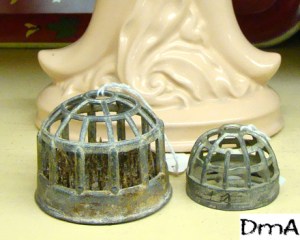
Recently, I took a break from everyday responsibilities, picked up my friend, Valerie, and went thrift and antiques shopping. My big purchase was a tiny flower frog (seen on the right in above photo) for five dollars at Second Hand Rose. I have three flower frogs now for my new collection fetish. This recent craze is an act of faith that someday I will have a cutting garden. Not a large garden, just big enough to fill the house with fresh bouquets and the hearts of those who enter with spring fever.

After I made my purchase, we walked a block down School Street, turned left down Pine Street to the Antiquarium. This shop (left photo) has everything imaginable from antiques and collectibles to new items. It’s a happy hand-on-your-heart moment when you enter. Overflowing merchandise beautifully displayed in eclectic fashion, from floor to tabletops to cabinetry ledges, cause you to pause instantly. A lot of thought and talent goes into purchasing and then displaying past and present so cleverly. I wanted it all, hundreds of primitive items carrying old stories, and modern treasures to compose a new journey.
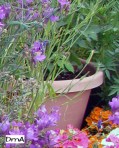
Exiting the Antiquarium, you pass through an open iron gate and walk by potted flowers. I wanted those too!

Valerie and I belong to the same garden club. Other than the monthly club events, this was our first outing together. With one exception, we’ve learned that we enjoy doing the same things:  gardening, reading, and thrift shopping. The exception is cooking. Valerie will go to Costco for her favorite breads, to another grocery store for special ingredients and others for bargains. I, however, use grocery stores like a drive thru; one stop, stock up, pay, and head out.

Valerie’s a great cook, as is a mutual friend, Dolores, who opened her home  to our spouses and us (a couple of days later) for a delicious Sunday meal. Valerie and Jim, Joe and I sat with Dolores and her husband, Tom, poolside at a round picnic table. Just as we began to fill our plates, a light breeze carried the aroma of ribs and garden-fresh vegetables into our nostrils then drifted over the gleaming pool water. Throughout the meal, conversations barreled into laughter as topics changed from pet raccoons to suicidal hens. Good times, good food, good people.
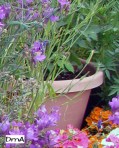
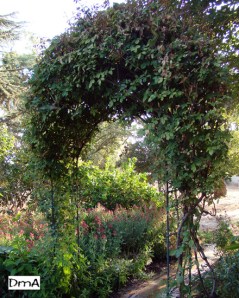
After dinner, I walked around the backyard. Vole trails and mounds riddled their lawn, but the perennial beds were lush and blooming (see photo above) with the brilliant sunset shining through. In the vegetable garden, a wilting pepper plant leaned precariously. At the base was a fresh critter mound. Tom grabbed a shovel and a black nursery bucket from the barn to pot the pepper plant. I haven’t heard yet if it survived. It probably wasn’t worth the effort. The shock will stop fruit from setting. Gardeners, however, never stop trying. Like parenting, the responsibilities of nurturing plants never escape the heart, whether we’re out shopping or dining with friends. Copyright © 2010 Dianne Marie Andre

h1

Shapely Plants: How to Grow Topiaries

September 7, 2010

  MyFreeCopyright.com Registered & Protected

I have always loved the nostalgic, old-world appearance of small topiaries. Their appealing shapes bring harmony and perfection to any space—on the porch, in the shade of a gazebo, or on a kitchen window ledge.

The word topiary comes from the Latin topiarius which means “a creator of places”. Is it any wonder that we view topiaries as living structures of tranquility? Beyond the visual pleasantries, topiaries bring culinary flavors when using herbs, and calm when trimming and nurturing its shape. I first discovered how therapeutic and fun topiary practice is after I received two spiral boxwoods for Christmas one year. The following spring, I nervously snipped the new growth with my little Dollar-Store scissors to maintain the appealing curves. I expected to grow weary of the task. Surprisingly, topiary shearing was a fun, creative process that relaxed me.

Topiaries are easy to grow, but they do take time to mature. If you want instant gratification, you can purchase an established topiary. But they come with a hefty price. With the use of cuttings, repurposed wire (or grape vines or willow branches) and hand-me-down pots, one can grow topiaries for pennies in five easy steps:

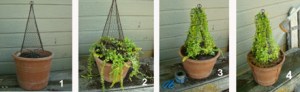
  1. Fill the pot with potting mix. (photo 1)
  2. Secure the frame in the pot with galvanized wire pins.
  3. Plant around the base of the frame. (photo 2)
  4. Gently wrap the foliage around the frame, or as seen in photo #3 hold in place with green twine.
  5. Water well. (photo 4)

 Tips

  • The size of the plant should match the scale of the topiary, i.e. medium-large leaves need heavier forms.
  • As new growth emerges in the spring, add time-release or liquid fertilize. Be sure to follow the package instructions. For herbs, use only organic fertilizer.
  • Wrap loose foliage around the frame. Snip where needed to control shape.
  • Pinch tips to promote side shoots.
  • Occasionally rinse the foliage.

Suggested plants for growing small topiaries indoors or in a protected area:

  • Creeping fig
  • Dwarf conifers
  • Dwarf or miniature rosebushes
  • German chamomile
  • Grape ivy
  • Juniper
  • Lavender
  • Rosemary, trailing or upright
  • Scented geranium
  • Small-leaved basil
  • Small-leaved fuchsias
  • Sweet bay
  • Thyme

Copyright © 2010 Dianne Marie Andre

h1

Happy Labor Day

September 6, 2010

Dear Friends,

Here’s wishing you relaxation, and old-fashioned family fun on summer’s last holiday.

Enjoy–Dianne

PS: Look for a new post tomorrow.

h1

Budding Garden Thoughts

September 3, 2010

“Gardeners live by faith,

 and with the acceptance of change,

they shift gears.”

Copyright © 2010 Dianne Marie Andre

h1

Hot August Contest Results

September 2, 2010

The winner of In and Around the Garden’s Hot August Contest is:

Betty L.

Congratulations Betty.

I hope you enjoy filling the photo album with special memories.

To those who played but didn’t win, your participation is greatly appreciated.

I loved all of your comments.

Thanks for making inandaroundthegarden.net

a great cyber place to garden, learn, and share.

Best regards–Dianne

h1

September Gardening Tasks

September 1, 2010

Please note:  What I write in this space are lessons learned through trial and error, research, and from other gardeners and professionals. I garden in zone 9, but share garden experiences that I believe are relevant to most zones within a reasonable time frame and planting conditions.

MyFreeCopyright.com Registered & Protected

September

MaintenanceAdjust water timers for cooler weather conditions by reducing frequency or time. Check batteries. As winds arrive, keep up with debris and damaged branches. Fall is the best time to plant so start researching, shopping around for trees, shrubs, and perennials that best fit your climate, zone, space, and maintenance needs. Start a new compost pile or add to the old one.

Check and secure or replace old stakes.

Store seeds you’ve gathered and dried in glass jars in a cool, dry place. Be sure to label them with the date and name.

If you keep a garden journal, now is a good time to update your summer triumphs and disappointments. Include favorite and least-favorite annual flowers and vegetable varieties, and why. If you purchased vegetable seeds from a catalog, jot down the information for reordering. Include the seed company’s name and contact information, just in case the catalog is misplaced.

In the vegetable garden:  Plant and sow cool-season crops: artichoke (sold as bare root), cabbage, cauliflower, broccoli, onions (right before rains), Brussels sprouts, beets, kale, peas (sweet and snap), carrots, radish, celery (cooking variety will grow year-round), turnip, mustard, parsley (Italian and curly can be grown all year), cilantro, spinach.

Transplant lettuce and strawberries.

In the landscapeRemove summer annuals. Add compost or manure to the soil. Late September, plant spring-blooming bulbs such as daffodils, narcissus, tulips, hyacinths, crocus, and iris. Avoid buying soft, moldy bulbs. They should be firm and plump. Once bulbs are in, plant fall annuals. These can include pansies, calendulas, snapdragons, violas, annual stock, California poppies, African daisies, bachelor’s buttons, forget-me-nots, Lobelia, alyssum, and Iceland poppies.

Divide old irises and perennials such as candytuft, daylily, agapanthus, and coreopsis after blooming. Before replanting, amend the soil.

Sow wildflower seeds. Treat roses for powdery mildew. Test for spider mites by shaking the plant over a white sheet of paper. Spray, if needed, with a recommended product from a reputable nursery.

Lay sod or sow seed for new lawns. Bare patches on old turfs can be seeded or filled in with sod.

Deadhead only summer-blooming shrubs.

Feed perennials and annuals one last time. Apply pre-emergent herbicide to lawns. Apply aluminum sulfate to hydrangeas for blue blossoms next year.

Copyright © 2010 Dianne Marie Andre 

h1

Upcoming Events

August 31, 2010

A list of things to do in September is now posted under “Events.”

h1

Vegetable Families

August 30, 2010


Below are several basic vegetable families. For best results grow and rotate each family together. They use the soil in comparable ways and share similar pests. 

Brassicas (cabbage family; sow on soil previously used for beans and peas): Broccoli | Brussels sprouts | all varieties of cabbage | kohl rabi | cauliflower | kale | mizuna | pak choi | radish | arugula | rutabaga | turnip

Legumes (bean and pea family): Snap peas | peas | bush | pole | lima | fava and dry beans

Solanaceae (potato and tomato family; grow with organic matter, as these are heavy feeders.): Eggplant | potato | tomato | peppers

Alliums (onion family; if planting in soils with lots of organic matter make sure it’s decomposed.):  Garlic, all varieties of onion, shallot, chive, leek

Umbeliferae (carrot and root family; for sweeter carrots grow during the winter then harvest in the spring.):  Celery | celeriac | cilantro | fennel | carrot | parsnip | parsley | dill

Cucurbits (squash and marrow family; heavy feeders so add organic matter to soil before planting.):  Summer and Winter squash | cucumber | melon | pumpkin 

Chenopodiaceae (beet family):  Swiss chard | spinach | beet 

Miscellaneous:  All fruit | mint | oregano | rosemary | sage| basil | lettuce | endive | cress | Jerusalem artichoke | corn | okra | corn salad | chicory Note: 

Don’t sow root vegetables in heavily fertilized soil. This will cause lush foliage and less root growth.