
Now that it’s time to plant cool-season vegetables, this is a good opportunity to start practicing crop rotation for healthy plants and soil. Let’s look at the benefits of crop rotation.
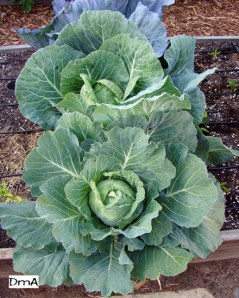 1) Help control disease and insects. For example, if you plant zucchini (or any annual vegetable) in the same place each year and the zucchini plant becomes infected with disease-causing agents, repeatedly, it will develop in the soil. Rotating your veggies will help prevent any disease buildup. This does take some planning and basic awareness of planting/rotating vegetable families together. (Monday’s post will cover vegetable families.)
2) Increase soil fertility and crop yield. Some plants deplete the soil while others add nutrients. Alternating plants will reduce the soil’s need for chemical fertilizers. By giving back what one plant steals from the soil your crops will receive nutrients needed to produce a good yield.
3) Opportunity to correct mistakes. Looking closer at your layout can help reduce problems like overcrowding, or planting heavy feeders twice in the same area leaving the soil depleted of nutrients.
4) Give your garden a new appearance. Let’s face it we all get bored. Spicing things up with creative rotation will give you a new lease on gardening.
If you’re fortunate to have a large area and/or raised beds, the ideal method is to divide your plot into four sections, A, B, C, and D. (It’s always fun to name them after your children or grandchildren.) One area or raised bed for example could contain perennial vegetables like asparagus, artichokes, and rhubarb. The other three areas would contain annual vegetable families. Every year, each vegetable family rotates together so that they’re not in the same site within a four-year period. If you don’t have perennial vegetables, let one area’s soil rest or fallow for a season or longer. If cats are a problem, cover the soil with a layer of straw.
To keep track of what you grew and where, record the information in a notepad. Recording crop rotation can be as simple or as detailed as you want. Some gardeners like to make a list of each area; others prefer to draw a diagram with detailed rows and plant names along with other details. Find a system that works for you. Once you get into the habit of this, you’ll find the planning process less time-consuming.
Whether or not you have the ideal landscape, whatever measure you are able to rotate crops it will be beneficial to them.
Copyright © 2010 Dianne Marie Andre

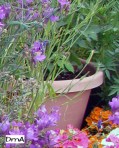

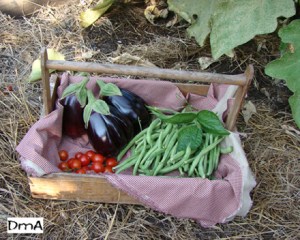 Since the weather has turned cold in the evenings and early mornings, vegetable yield and maturity has slowed down. The plants have lost their healthy charm and now look frail and tired with a dying-off appearance. A new season is coming.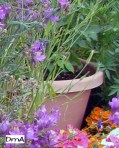
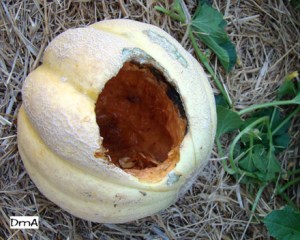 In the vegetable bed, voles have devoured two cantaloupes, one ready to harvest and the other green as grass. Voles run above ground on the paths they’ve created between holes. I placed two mousetraps and four glue traps on the running trails. If you place two traps back-to-back on the paths, you’re bound to capture one. So far, I’ve caught four. I plunked a blend of peanut butter and oatmeal on each, although a small piece of spearmint gum seems to attract them better. Ralphie, however, is also attracted to the gum, not the peanut butter, so I have to go with the latter.
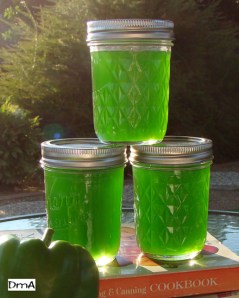 This year I decided to grow green peppers to make my green pepper jelly with some extra to sell at a Christmas boutique in which I participate. I planted twelve plants and they are producing well. I rounded up my mother and father’s old blue canner. Keep in mind I have not canned for about 25 years. I had given all my canning jars away thinking I would not be canning again.
 THE PRIZE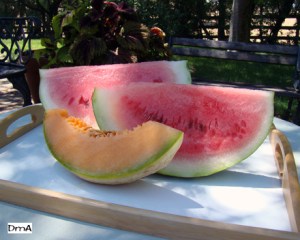


 In and Around the Garden