January Events is now posted for family recreation and learning opportunities.


Vertical Habitats
December 20, 2010Only one tree fell during the weekend’s storm. I’m crossing my fingers that the trees throughout our property will stay grounded, limbs in tact, during the remainder of this, and other winter tempests. I hate the thought of losing any of my husband’s trees. They are, after all, earth’s great big, green friends, and ours.
Joe is the one who designed, bought, and planted (with our sons’ help and mine) more than one thousand trees. Over the years, we’ve watched them grow from seedlings and five-gallon-sized adolescents into maturity. My husband has fussed over their need for water, weeding, staking, and pruning. A great deal of forethought and labor has gone into the continued nurturing of Joe’s trees.
We’ve received enormous pleasure from his vertical habitats. The trees have added value and beauty to our land, shaped a welcoming entrance to our home, purified the atmosphere, formed windbreaks and screens to hide junk piles and farm equipment, and provided quarters and refuges for critters.
We’ve lost several trees over the years. Seven weeping willows were removed, evergreens, birch, mulberry, locusts, cherries, and an orange tree. To this day, large voids remain where they once stood. When I squint, I can see their ghostly figures. Losing trees isn’t the end of the world. It’s the end of a big, beautiful, green friend. I can’t help feeling a tad sad when this happens.
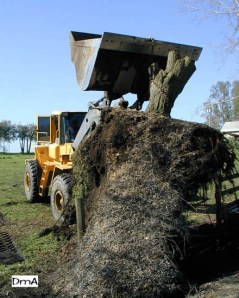
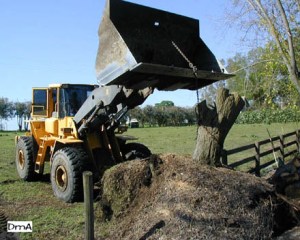
This is one of the weeping willow trees we had to remove.
Budding Garden Thought
December 17, 2010

“White flakes of snow
remind me of my rose.
A warm garnish beneath my nose.”
Copyright © 2010 Dianne Marie Andre
Bare-Root Roses
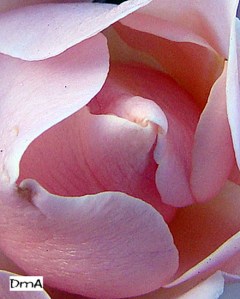
December 16, 2010It’s time for bare-root roses. Shop now at your local nursery for old-time favorites as well as the new 2011 varieties such as Dick Clark.
To view some of these beauties go to:
http://www.ridgeroadgardencenter.com/bareroot_roses2011.htm
Tell them In and Around the Garden sent you!
How to Thin Root Vegetables
December 15, 2010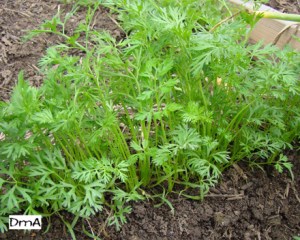
Thinning root-vegetable seedlings is important for good growth development. Proper spacing between plants reduces an underground battle for water, nutrients, room to expand, and air circulation. As you can see in the photo above, these carrots are too thick. One can avoid this by spacing seeds correctly when planting, but that is tedious work, especially with fine seeds. Although sowing fine, tiny seeds mixed with sand does help with better distribution and spacing, you will still need to do some thinning.
Here are some tips to make thinning root seedlings easier:
- Thin when seedlings have 1-2 sets of true leaves or reach a height of 2-3 inches.
- Soil should be damp not soggy. Damp soil will make it easier to extract only those seedlings you want to remove. Soggy soil acts like glue making it difficult for roots to separate from one another.
- Remove the smaller, thinner, weak seedlings.
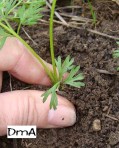
- Before thinning, use your thumb and forefinger to secure the good seedling, then gently pull up the undesirable plant.
- Mound soil around wobbly seedlings to secure them.
- You can do two thinnings, three or four weeks apart.
- Work discarded seedlings into the soil or toss into the compost pile. (Lettuce, beets, and spinach can be used in salads.)
Spacing between root vegetables varies according to varieties. Refer to your seed packet or use these basic guidelines:
- Beets: 3-6″ apart
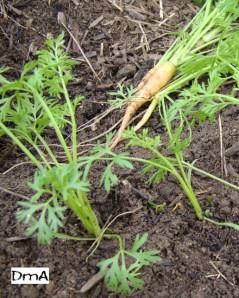
- Carrots: 2-3″ apart**
- Lettuce: 18-24″ apart
- Onions: 3-5″ apart
- Parsnips: 3-6″ apart
- Radishes: 2-3″ apart
- Rutabagas: 8″ apart
- Spinach: 2-6″ apart
- Turnips: 2-4″ apart**
**When thinning carrots and turnips, carefully remove one plant at a time. Disturbing the roots of these vegetables can cause deformities. Copyright © 2010 Dianne Marie Andre
Discovering a new Passion
December 14, 2010
Dianne Poinski
The work area consisted of two tables covered in white butcher paper, neatly set with art supplies like an élite dinner party for honored guests. This was serious stuff, and like Julie Roberts in the restaurant scene of Pretty Woman, I was nervous about the proper use of each utensil. After walking around the studio, though, I couldn’t help relax. Dianne’s photography combined with a unique talent for hand coloring drew me into a world of harmony and peace.
Our first assignment involved hand coloring a black-and-white country scene with mountains, grass, and sky. I sat at the table like a kindergartener on her first day of school, pleased with the familiarity in the photo, but unsure what to do first. Dianne gave a through demonstration, and afterwards the other three ladies at my table immediately began coloring. I hesitated. I wanted little paint-by-numbers to magically appear on my print. Realizing this wasn’t going to happen, I picked up a wooden-handled sponge, dipped the tip into a light-green tint, and gave my photo some color.
The moment my sponge touched the mountaintop, I fell in love with the process of colorizing black and white photos. The more shades I experimented with the more I felt connected to the country scene resembling home. I can do this, I thought. The benefit of creating something that didn’t require electricity, a mouse, a monitor, or a clicking keyboard was downright liberating.
By the end of the day I had colored four black and white prints, two of Dianne’s and two that I had emailed to her prior to the workshop. Here’s one of my finished photographs.
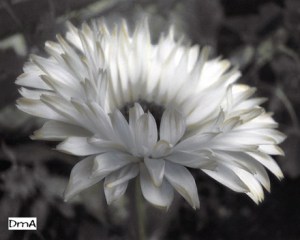
Dianne Poinski’s images are available worldwide as prints published by Portal Publishing and Bentley Publishing Group. For more information go to www.dpoinski.com or visit Dianne at her studio the second Saturday each month at 1021 R Street, 2nd floor, Sacramento. Dianne can also be found on Facebook and Twitter.
Ralphie’s Gift-Giving Book List for Pet Lovers
December 13, 2010 Ralphie and I love a good book about furry companions. Often, around mid-day, we’ll stretch out on the sofa where I read to Ralphie until he falls asleep. Together, we’ve enjoyed the lives of dogs and cats, and the many surprising details about farm animals, humming birds, bees, and more. Our favorite books, of course are about dogs.
Since this is gift-giving season, Ralphie and I want to encourage you to give books to your pals and their furry buddies, so we came up with a list of books that we’ve enjoyed together. “Ruff.”
PS: Tell us what your favorite books are.
New York Times Bestseller Dewey: The Small Town Library Cat Who Touched the World By Vicki Myron. | This is a heartwarming story about an internationally famous cat’s life at the Spencer Public Library in Iowa, and the librarian who raised him.
 A Field Guide to Cows by John Pukite | Informative, amazing, and amusing, A Field Guide to Cows is the indispensable companion for would-be cow tippers, farmers, city folk, agriculturalists, interstate drivers, 4-H’ers, vacationing families, and everyone who likes to moo at cows.
 Chickens: Tending a Small-Scale Flock for Pleasure and Profit by Sue Weaver | From hens to roosters, from layers to broilers, Weaver covers the essentials in a straight forward style. You won’t need to worry about your chickens flying the coop with this resource in hand.
Izzy & Lenore by Jon Katz | If you enjoy good dog stories, this book will touch your heart. The book really is uplifting and once again points out the amazing effects that pets can have on the lives of human beings. Izzy is a marvel of a dog. Katz is a wonderful author.
Budding Garden Thoughts
December 10, 2010

Winter days stretch endlessly.
The cold, the rain, and the tulle fog hang.
Copyright © 2010 Dianne Marie Andre
Proper indoor Care for Living Christmas Trees
December 9, 2010Here are some helpful hints to keep your living Christmas tree happy and alive.
- Always pick up your tree by the container or ball-and-burlap, not by the trunk.
- After you bring your living tree home, immediately place it in a covered porch, patio, in the garage or shed for a few days. This will help prepare it for indoor conditions.
- If possible, don’t keep your living tree indoors for more than seven days.
- Once indoors, keep your tree in the original pot or its burlap wrapping.
- Don’t place your living tree (or any tree) near heat sources such as fireplaces, vents, wall units.
- Whether you choose a potted or ball-and-burlap tree, protect your floor or carpet with a saucer, or drip pan. If you slip the ball-and-burlap tree inside a decorative container, make such it has drainage holes so the root ball doesn’t sit in water.
- Don’t let your tree’s soil or root ball dry out. Check daily and keep moist, not soggy.
- If you string Christmas lights around your living tree, use miniature or LED lights to minimize burning the needles. Also, limit the time you keep them turned on. A timer works great for tree lights, and other decorations.
When you are ready to relocate your living tree outside, place it in a sheltered area such as a covered porch, patio, inside the garage or shed for a few days to prepare it for outdoor conditions. Plant it according to the nursery tag where it has plenty of growing space, in well-draining soil.


 In and Around the Garden