
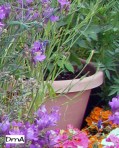
“Step outdoors.
Inhale fresh oxygen,
deep and soulful
and the earth is yours.”
Copyright © 2010 Dianne Marie Andre

“Step outdoors.
Inhale fresh oxygen,
deep and soulful
and the earth is yours.”
Copyright © 2010 Dianne Marie Andre
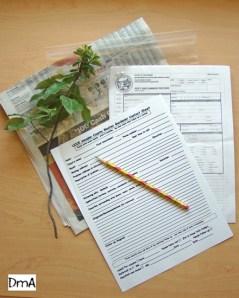
For insect and disease diagnosis, yesterday’s article mentioned two referrals: California Pest Prevention Services and your local Master Gardeners Association. It’s important that you give as much information as possible when seeking their assistance. Below is an overview of what type of questions you can expect to answer.
The current form at the California Pest Prevention Services office asks for the following information:
Basic questions your local Master Gardeners may ask.
Further information that Master Gardeners may need could include, but are not limited to the following:
Of course, both organizations will need your name, location, and county. The environment, conditions, and care involving a plant are important factors in diagnosing a problem. So be ready to give as much information as possible.
As stated below, provide a good sample. The sample should be fresh, placed between two sheets of newspaper or paper towels in a baggie.
*If you don’t know the name, they can help identify the plant. Provide a good sample (leaf, stem, and flower) and a photo of the plant/tree.
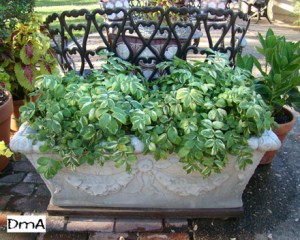
Several weeks ago, I noticed that the leaves on two “Stairway to Heaven Jacob’s Ladder” (Polemonium reptans) were sticky. Thinking aphids had infected them, I hosed both plants (above photo ) off after each watering. I did this for two or three weeks. It was only when the lower, underneath leaves turned yellow that a serious problem became clear.
Spreading the plants apart for a slower look, I saw hundreds of insects feasting on the stems and leaves. I took a sample to the Amador Master Gardener’s office and learned that the insect was scales. Scales are so small they are difficult to spot in the beginning. Still, if I had paid attention, looked deeper, taken more interest maybe the scales could have been controllable. Now, there’s a chance scales will infect neighboring potted plants.
Here’s what I found in my Pests of Landscape Trees and Shrubs book on scales:
“The newly hatched scale nymphs, called crawlers, emerge and walk along branches or are spread by the wind or inadvertently by people or animals. Scale crawlers are usually pale yellow to orange and about the size of the period. Within 1 to a few days, crawlers settle and insert their strawlike mouthparts to feed on plant juices. After settling, armored scales secrete a waxy covering and remain on the same plant part for the rest of their lives; nymphs of soft scale species can move a little, usually from foliage to bark before leaves drop in the fall.”

Considering how infested the plants were and that scales live on the plant(s) for a lifetime, and can easily spread, I pulled them out and placed them in a tightly sealed bag for the incinerator. Before doing this, I saved a sample to submit to the State of California Pest Prevention Services in Sacramento. Identifying what type of scale may help eliminate or control any future spread of this insect.
For information on how you can submit samples troubled with disease or insects to the California Pest Prevention Services, call 1-919-262-1100. Forms and submission information is not available online. However, their website http://www.cdfa.ca.gov/phpps is worth viewing.
If you have an insect from the United States or Canada, and want it identified, you can upload images at http://bugguide.net. (If you misplace the web address, you can find it here, under Helpful Resources.) This is an amazing sight, from which the family can benefit.
Your local master gardeners can also help identify insects and disease, and offer possible solutions.
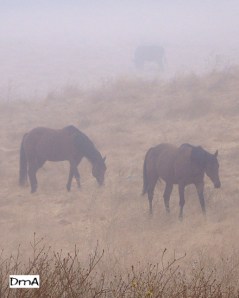
I didn’t expect fog yesterday morning. The mist surprised me as I watched the reduced visibility across the land. Flirtation of heavy drizzle dampened the earth and the leaves beneath my shoes. Peaceful as it felt, I’m not ready for the movements of change.
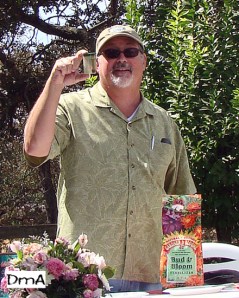 Finally, I met “Farmer Fred” Hoffman. Farmer Fred is a lifetime master gardener—a celebrity around these parts—who shares his colossal horticulture knowledge as host of the “KFBK Garden Show” on NewsTalk 1530 KFBK in Sacramento, California, Sunday mornings from 8:30 a.m. to 10 a.m., followed by “Get Growing” on Talk 650 KSTE in Sacramento, 10 a.m. to Noon.
On the occasion when I met Farmer Fred, he was the guest speaker for a small group of Clements Garden Club members. It was a casual affair in the backyard of one of the members, only two miles from my house. Garbed in sunglasses and a Kellogg’s cap, Farmer Fred shared tips, and answered questions with zeal and a bit of humor. Here are some of his helpful gardening hints:
When I asked Farmer Fred about sunscald on pepper plants (Betty with question was for you.), he said he’s learned to live with it. “There’s nothing wrong with them.” Farmer Fred spaces his pepper plants 18 inches apart.
Farmer Fred also commented that voles are smart. They quickly learn how to avoid traps. “There’s really nothing you can do about them,” Fred said. “Voles are cyclical.” He wasn’t in favor of poisons because of secondary infection to pets and other animals.
Farmer Fred’s favorite cherry tomatoes include sweet million, sweet gold, and sun gold.
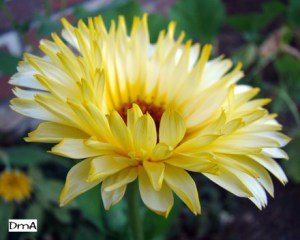
To my readers, a flower, and a wish for a wonderful weekend:
“Small as a dandelion, prettier than gold
Yellow flower you cause me to smile.
What’s your name?
No matter. Here in a photo, your image I share,
To those who love pretty yellow flowers . . .
Prettier than gold.”
Copyright © 2010 Dianne Marie Andre
“Favorite things:
gracious living,
family, friends,
and earth.”
Copyright © 2010 Dianne Marie Andre
It’s contest time again. Starting today, September 15, same game, same rules, different prize: Lowe’s $10 Gift Card.

Here’s the rules and game plan:
Best of luck and happy commenting!
Note: In and Around the Garden and/or the author has the right to refuse publication of comment(s) unsuitable and/or to exclude them in the above contest. In and Around the Garden and/or the author also has the right to decide what comments are unsuitable. By playing the ‘September Readers’ Contest’, you agree to these terms.
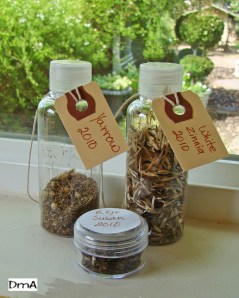 As the season winds down and annuals fade away, it’s hard to imagine your garden beds empty of colorful flowers. Collecting seeds from favorite annuals is a sure-fire way to reproduce them for next year. It’s also an economical way to fill your beds with lots of flowers that you may not otherwise afford. Depending on the annual, one pod can hold hundreds of seeds.
Seed collection also allows you the proud experience of propagating annuals from your garden, preserving heirloom varieties, and creating unique holiday gifts.
Supply List:
Collecting Steps:
Tips:
Copyright © 2010 Dianne Marie Andre
It was the end of the day, just before the eggs are gathered and the hens secured for the night, when I began watering the potted plants around the outside of the house. Ralphie was with me, sniffing the bushes and the air. The faucet, and hose with an adjustable nozzle on the end is next to marigolds in a tall, wrought iron wall stand, so I water them first. Feeling the fall air against my back, I was in deep thought about fall annuals when a vole suddenly ran up the wall and under the fascia board. I quickly turned the nozzle to ‘jet’ to flush out the vole. For some reason, I thought I was fast enough to drop the hose (should he reappear), grab the nearby shovel, and whack him flat. I aimed the jet spray into the narrow crack along the length of the fascia board. Coming to the end of a small opening, he flew out and landed on the porch wall, several feet away.
That was when I thought, “Hey, voles don’t have wings. Bats do!”
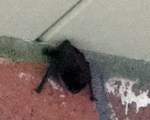 Ralphie was at my side by then; his head tilted wondering why I was moving so fast. I put the hose down and ran for the camera. As I tried to get a good photo, some distance away (I need a better camera for long-range photography), the poor bat was desperately searching for a crack between the ceiling and the wall, for another safe haven. Once I clicked the camera, I let the bat alone, and watered the large ivy topiaries a couple of feet away. It takes a few minutes for the water to run out of the bottom of the pots, so I sat on the bench when out jumped a dozen tiny frogs. They congregated around my shoes—also looking for a safe haven. Not a bad idea.
I’m not afraid of frogs, voles, or bats. They’re harmless, especially the frogs who in their own way are adorable. I just don’t like to openly engage in the company of voles and bats. Gardening is more pleasurable when critters of certain types remain concealed underground, or tucked beneath a bush. They can live on my land, in the gardens and potted plants as long as they stay out-of-sight and leave my plants and me alone.
I’m grateful for the benefits critters bring to nature and the garden. Nevertheless, there is something edgy about gardening beside visible voles and bats. This isn’t a child’s storybook with talking animals. With the bat overhead, frogs at my feet, and a vole playing hide-and-seek, it was time to tend to the hens, and then call it a day. The watering could wait until morning.
Bats Facts:
Copyright © 2010 Dianne Marie Andre


 | Aimee E on Slanted Light |
 | Anonymous on A Lesson in Forced Blub F… |
 | Corinne W on I have Argyranthemum Frut… |
 | Dianne Marie Andre on How to Deadhead Snapdrago… |
| Anonymous on How to Deadhead Snapdrago… |

 In and Around the Garden