Archive for the ‘Dianne's Blog’ Category
 March 12, 2012
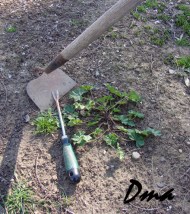 Home gardeners wait all winter for spring, for tender shoots of green hues and rainbow-colored flower buds. Then beneath them, undesirable weeds appear indent on taking over the landscape. We hoe, dig, spray, perspire, and swear in our battle to kill them—to maintain a tidy landscape. Unfortunately, like a chronic habit they keep coming back. Nevertheless, there are other reasons to rid your yard of weeds.
Weeds:
- Steal space, nutrients, water, and sunlight from crops.
- Provide cover for pests and rodents.
- Cause many allergens to people.
- Serve as host for insects and overwintering diseases.
Before waging war against weeds, use tools that best suit your weeding preference, i.e., on your feet or on the earth with a hand tool. Select tools that fit your hand size and strength ability. If the tool is too big or heavy, the job will be harder than necessary.
Tool Care and Safety:
- A good rule is to sharpen hoe blades every eight hours of use.
- Sharpen the blade to a 45-degree angle with a file just enough to remove ragged portions of the blade.
- Never leave the blade end down while working in the garden. One can easily step on the blade and send the handle flying toward the face. For the same reason, store garden hoes with blade-end facing up.
Weed Control:
- Remove and properly dispose of weeds before they flower and go to seed. One head can contain thousands of seeds. Avoid putting weeds in a compost pile that does not remain hot (over 130 degrees F.) for several days. The seeds will not decompose.
- Develop a regular weeding routine. Remove weeds weekly, if possible every time you see one.
- Make sure the soil is moist (not soaking wet) one – two inches deep for easy weeding.
- Annual weeds will die if cut at or below the soil line. Perennial weeds grow back if you don’t remove the taproot.
- Disturb the soil as little as possible. Seeds are viable in the soil for hundreds of years waiting to germinate when the conditions are right. Cultivating the soil causes seeds to surface to the top.
Number One Earth-Friendly Weed Control:
- The best and easiest way to help eliminate as many weeds as possible is to use organic mulch, after you have removed all weeds. A thick layer of four – six inches will block out light required for germination of some seeds. The few weeds that do germinate easily come up—roots included—simply by using your fingers. Mulch helps retain moisture, is attractive, and environmentally friendly. (Note: To help prevent moisture rot, disease, and insects from crawling up plants, Keep mulch three inches away from the base of tree and plants.)
Posted in Dianne's Blog | Tagged annual weeds, best way to decrease weeds, flower buds, garden tool safety, Germination, Hand tool, Mulch, perennial weeds, undesirable weeds, Weed control, weed tools | 2 Comments »
March 9, 2012
A Cool Thing:
Read this interesting article on possible future agriculture using LEDs, climate and water control indoors.
Tip:
1) Want butterflies to your garden? Provide a water source like a shallow bowl filled with a few stones for the butterflies to land on and grab a drink.
FYI:
1) A ‘Search Box’ is now added at the top of the sidebar. This will allow you to search for a topic, name, etc. within In and Around the Garden. If the full article does not appear, simply click on the article’s title.
2) In and Around the Garden now has it’s own Facebook user name: facebook.com/inandaroundthegarden
Posted in Dianne's Blog | Tagged agriculture, Butterflies, Facebook, LED, Sowing, water source | 2 Comments »
March 7, 2012
Here are two garden reminders that will keep your fingers in the soil, your body fit, and your yard the envy of every neighbor.
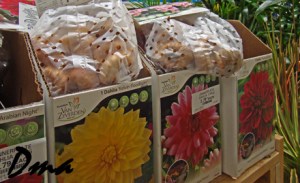
For summer color spots and cut flowers, plant bulbs as soon as the ground isn’t too wet or frozen. Buy now to get cream of the crop bulbs. Select bulbs that are firm, not soft. The most common summer-blooming bulbs include lilies, tuberous begonias, dahlias, and gladiolus. For beautiful mixed bouquets throughout the summer months, plant each variety every seven to fourteen days.
Just what you’ve been waiting all winter to do!

“Gardening requires lots of water – most of it in the form of perspiration.” –Lou Erickson
Posted in Dianne's Blog | Tagged Bulb, cut flowers, dahlias, Garden, gladiolas, Horticulture, lilies, plant, plant bulbs, summer blooming bulbs, tuberous begonias, weeding | 1 Comment »
March 5, 2012
The bridge between winter and spring
March is a maddening interval for gardeners. Oftentimes, the soil is still too wet or cold to work. Gardeners go stir crazy itching to dig into the soil, amend beds, and plant until his or her body aches from bending over. Flipping through garden catalogs and magazines only worsens the desire to get close to nature. My solution is to repot, replace potting mix, or create new plantings in unused or new containers.
Conditions for repotting:
Start by checking the existing potted plants around your landscape to see if the plants are root bound or if the mix has hardened, a sure sign it no longer allows good oxygen circulation needed for healthy roots. There are three ways to check the condition of the soil in potted plants: 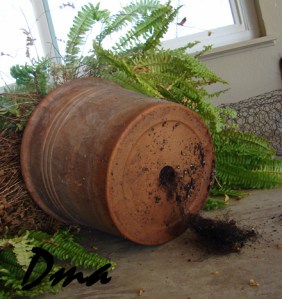 1) look for roots reaching outside the drainage hole; 2) if the soil is moist, gently lift the plant out of the pot. If there are more roots than soil, it’s time to repot; 3) stick a hand trowel into the soil six inches deep to see if the soil is compacted or fluffy.
Type of outdoor potting mix
These days, most gardeners can’t afford the ‘best’ potting mix but if possible avoid purchasing the ‘cheapest’. Choose an all-purpose blend of organic matter like peat moss, garden loam, or manure, and perlite. Together these will provide proper drainage and oxygen flow to the roots.
Now comes the fun part
Before heading to your local nursery, note the size pot required of each plant being repotted and how much potting mix you’ll need for this task or if you’re simply replacing the old mix. If you’re starting from scratch select plants with same light and water requirements. When freezing temperatures is a danger, protect frost sensitive plants.
Planting up a pot or two will help diminish the stir-crazy itch of waiting to cross the bridge from winter and spring.
Posted in Dianne's Blog | Tagged Container garden, Garden, garden loam, Organic matter, peat moss, perlite, plant, plant selection, pot selection, Potting soil, root bound, Soil | 1 Comment »
March 2, 2012
A Cool Thing:
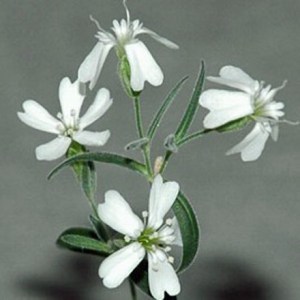
Unbelievable! Scientists resurrected this Ice Age plant after 30,000 years in deep freeze.
Tip:
I have added a link listing poisonous plants for livestock and critters living in California, to the ‘Helpful Resources’ page.
Posted in Dianne's Blog | Tagged California, Garden, garden hints, garden tips, Growing season, helpful resources, Ice age, ice age plant, poisonous plant list, science | 1 Comment »
February 27, 2012
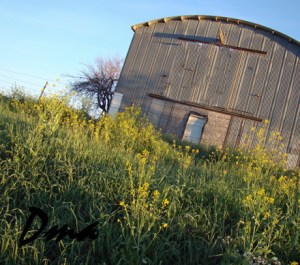 When March arrives, I get excited because nature and garden events are in full swing in and around my neighborhood.
Every spring there is someplace new to discover, things to learn, and be inspired by.
This year, I just learned about the beautiful wildflower tour at North Table Mountain Ecological Reserve, one hour north of Sacramento. Tours run March through April, and fill up fast. If you’re interested, click on the link above or call 916-358-2869.
Click here for other March events.
Note: The above photo was taken near my home.
Posted in Dianne's Blog | Tagged 2012 spring events, ecological reserve, garden tours, March Days, nature tours, neighborhood, North Table Mountain Ecological Reserve, photo, Sacramento California | 1 Comment »
February 24, 2012
TIP:
To keep insecticides from going into the soil, cut old garden hoses into 24-inch lengths. Close off one end by stuffing paper into the opening. Then slip an old funnel or make one out of paper into the other end and carefully fill leaving room for insects to crawl inside. To prevent pets and children from playing with them, secure with U-shaped landscape anchoring pins. To avoid spillage, remove the stuffed paper after laying the hose in the desired area. Before removing the hoses, keep in a horizontal position and close off each end so the dead bugs and insecticide won’t spill out before properly discarding.
Note: Always: 1) wear gloves; 2) write ‘poison’ on hose lengths and on the old funnel. When not in use, store out of children’s reach; 3) properly discard paper funnel.
HINT:
To remove garden stains from hands add a teaspoon of sugar to soapy water before washing.
A COOL THING:
The largest rose in the world, planted in 1855 at the Rose Tree Inn, Tombstone, Arizona, covers over 8,000 square feet on a very large trellis.
Posted in Dianne's Blog | Tagged dead bugs, Earwig, Funnel, garden hoses, Gardens, Insecticide, largest rose in the world, plant, Rose Tree Inn, soapy water, Tombstone Arizona, wear gloves | Leave a Comment »
February 22, 2012
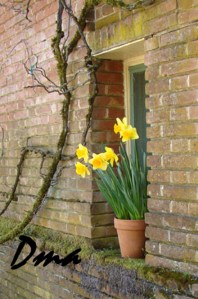 With the onset of spring-like weather, it is tempting to put away frost cloths and to plant vegetation and sow seeds outdoors. But, don’t let the sunshine, green field grasses, and emerging buds fool you. Frost and frozen ground can kill or damage plants and seeds leaving you frustrated, discouraged, and broke.
If you are new to gardening or have recently moved, ask your local Master Gardener Chapter or professional nursery person for your zone’s last frost date. They can also tell you what zone you live in or plug in your zip code here to find out. But remember there is more than one zone system. Guest writer and master gardener Robin Ivanoff explains here.
Posted in Dianne's Blog | Tagged damage plants, find us on twitter, Garden, Growing season, Home garden, last frost date, Master Gardeners, Microclimate, plant, plants and seeds, Seed | 1 Comment »
February 20, 2012
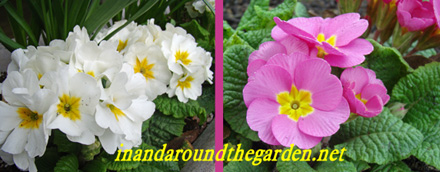
The beauty of primroses is they bloom from winter to mid-spring and when the sky is grey you are sure to have hues of sunshine in the landscape.
Although it is best to plant primroses in autumn to establish good root development, they are usually available in six packs fall through springtime. The white primroses above were planted a little over a week ago and the pink ones are two years old returning from their slumber.
Primroses:
- Grow in zones 1-10, 12-24 in part sun, preferably morning sun.
- Are considered a perennial that dies back in hot weather.
- Are used as color spot in beds, borders, containers, and for naturalizing areas.
- Can be grown from seed indoors then transplanted.
- Prefer well-drained soil in amended organic matter. Poor drainage will cause crown and root rot. Give Feed just before blooming with a light organic fertilize.
- Remove spent blooms and dead leaves.
- Water during summer even after they die back with little water come fall. If you like, transplant to a cool dry place, out of sight, during hot months then re-transplant in autumn.
Posted in Dianne's Blog | Tagged borders, color spots, good root development, growing primroses, naturalizing, poor drainage, primroses, root development, root rot | 2 Comments »
February 17, 2012
A Cool Thing:
One of my photographs is being debuted on Nancy F.’s webpage,
Eye Candy of Another Kind on Pinterest.
Thanks Nancy for pinning my photo on your wall!
Tip:
February is the month to
1) fertilize asparagus and strawberries;
2) finish pruning roses;
3) prune Crepe Myrtles
Posted in Dianne's Blog | Tagged cool thing, crepe myrtles, eye candy, February, Garden, monthly garden chores, photo debute, photography, pruning, pruning roses, Rose, strawberries | 1 Comment »


 In and Around the Garden