
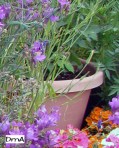
Winter days stretch endlessly.
The cold, the rain, and the tulle fog hang.
Copyright © 2010 Dianne Marie Andre

Winter days stretch endlessly.
The cold, the rain, and the tulle fog hang.
Copyright © 2010 Dianne Marie Andre
Here are some helpful hints to keep your living Christmas tree happy and alive.
When you are ready to relocate your living tree outside, place it in a sheltered area such as a covered porch, patio, inside the garage or shed for a few days to prepare it for outdoor conditions. Plant it according to the nursery tag where it has plenty of growing space, in well-draining soil.
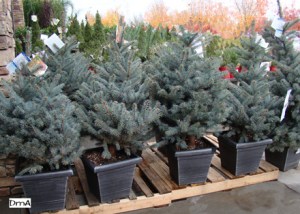
I wish every family could experience, at least once, the pleasures of having a living Christmas tree. It’s a wonderful way to honor a loved one or to mark a special milestone or occasion, first indoors adorned with ornaments, then outdoors where family and neighbors can enjoy it for years to come.
Every day I look through the windows at my living tree, a blue spruce. It anchors the perennial garden’s northeast corner. My husband surprised me with it one Christmas after learning that I had cancer. Eighteen years later, the blue spruce stands tall and bold, a thriving celebration of life.
If you don’t have outdoor space for a living Christmas tree, consider donating it after the holidays to your favorite park, community organization, school, or church. If you have outdoor space for a potted tree, choose a slow growing or dwarf variety.
Living trees do cost more than a cut tree, but it will give you years of pleasure. Here are some tips to help you choose the right tree:
Tomorrow: Tips on caring for your living Christmas tree.
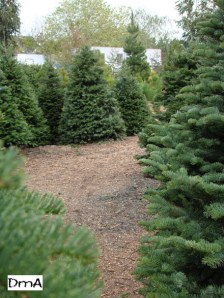
To find choose-and-cut Christmas tree farms by county go to:
http://www.cachristmas.com/ChooseandCutFrame.html
In addition to general information (address, contact numbers, website, etc.), this site also provides a key showing services and fun activities for the whole family that is offered at each farm.
Note: Before going to the tree farm of your choice, first visit their website or call to confirm services provided, days/times of special events like hayrides, and hours.
 Poinsettia Care Tips:
Poinsettia Facts:
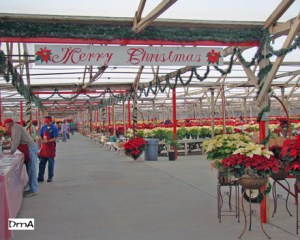
Each year Duarte Nursery, near Modesto, California, opens their Poinsettia greenhouse to the public the first Saturday after Thanksgiving Day. The Poinsettia greenhouse sits on a 180-acre complex where the Duarte family grows mostly fruit and nut trees, vines, and 60,000 Poinsettias. Because Duarte Nursery sells to commercial growers, opening their doors to the public each November provides an opportunity to share the Christmas spirit by interacting with the community.
With over 30 Poinsettia varieties and colors, you can choose pinks, reds, burgundy, creamy white, yellow, marbled, mottled, wavy, Poinsettia trees, arrangements, pots, and vases. However, I should warn you, as you walk between the aisles, it’s impossible to choose the best and prettiest Poinsettia because each one is equally superb. The foliage is dark green, perky and plentiful. The bracts are vibrant, aesthetically balanced with dense, full growth from all angles. You won’t find one brown spot, yellow or wilting leaf. Duarte Nursery grows Poinsettias with perfection in mind.
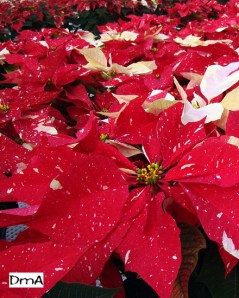
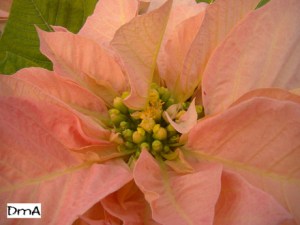
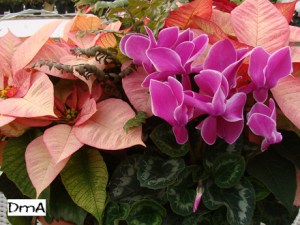
Poinsettia hours are Monday-Saturday 8am-5pm & Sunday 10am-4pm. Poinsettias start at $8/ea.
Duarte Nursery is located at 1555 Baldwin Road, Hughson, California 95326
Phone: 209-531-0351 | Fax: 209-531-0352 | email: sales@duartenursery.com
Monday, look for Poinsettia Care Tips and Facts
Please note: What I write in this space are lessons learned through trial and error, research, and from other gardeners and professionals. I garden in zone 9, but share garden experiences that I believe are relevant to most zones within a reasonable time frame and planting conditions.
Maintenance: Keep faucets, pipes, and sprinkler valves protected from frost by wrapping them with old bath towels or rags. Double check tree stakes and support wire. Slip flexible pipes over the end of downspouts to redirect rainwater away from the house.
In the vegetable garden: Most winter vegetables can handle frost and snow, however, a harsh wind can cripple or destroy them. Watch the weather report and be ready to protect your winter crops from wind.
In the soil, sow seeds of lettuce, carrots, fava beans, mustard, peas, radishes, bunching onions, onions, bok choy, broccoli, kale, collards, and spinach.
Plant from cell packs of broccoli and cauliflower.
Plant barefoot berries, grapes, fruit trees, asparagus, artichokes, strawberries, rhubarb.
In the landscape: Keep covering frost-sensitive plants with frost cloth. Watch the soil in potted plants and don’t let it dry out.
In the ground or in pots, plant the following annuals: Iceland poppies, pansies, violas, calendulas, flowering kale, flowering cabbage, sweet William, snapdragons, cyclamen, primroses.
At the nursery, select camellias while they are budding. This will allow you to see the flower colors first-hand.
If the ground isn’t frozen, you can still plant daffodil bulbs.
Prune rose bushes.
Copyright © 2010 Dianne Marie Andre
The December events has been posted. Now, go out and have some fun before the year is gone.
After I got home from the library yesterday, my landline phone was working. Go figure. Still, the phone company came out today and tried to find the problem so it wouldn’t happen again for the third time, but my phones have to be down to locate the trouble.
The good news is that it is outside the house. The bad news is that it will probably happen again, and if I can’t get Verizon to come out while the phone is out-of-order (this only happens when it rains), I just have to wait for the “problem spot” to dry out.
The repairman told me that another couple with the same issue went 18 days without service. So, if you don’t hear from me for a while in the near future, most likely it’s because I can’t go on-line.
I sure do appreciate your patience with a country gal and her rural-living troubles.
PS: If anyone has a laptop that you don’t use and would like to donate it to “In and Around the Garden” so that I can at least go to a coffee shop to communicate as often as possible when I’m offline, I’d be grateful for the gift.
You are currently browsing the In and Around the Garden blog archives for December, 2010.


 | Aimee E on Slanted Light |
 | Anonymous on A Lesson in Forced Blub F… |
 | Corinne W on I have Argyranthemum Frut… |
 | Dianne Marie Andre on How to Deadhead Snapdrago… |
| Anonymous on How to Deadhead Snapdrago… |

 In and Around the Garden